
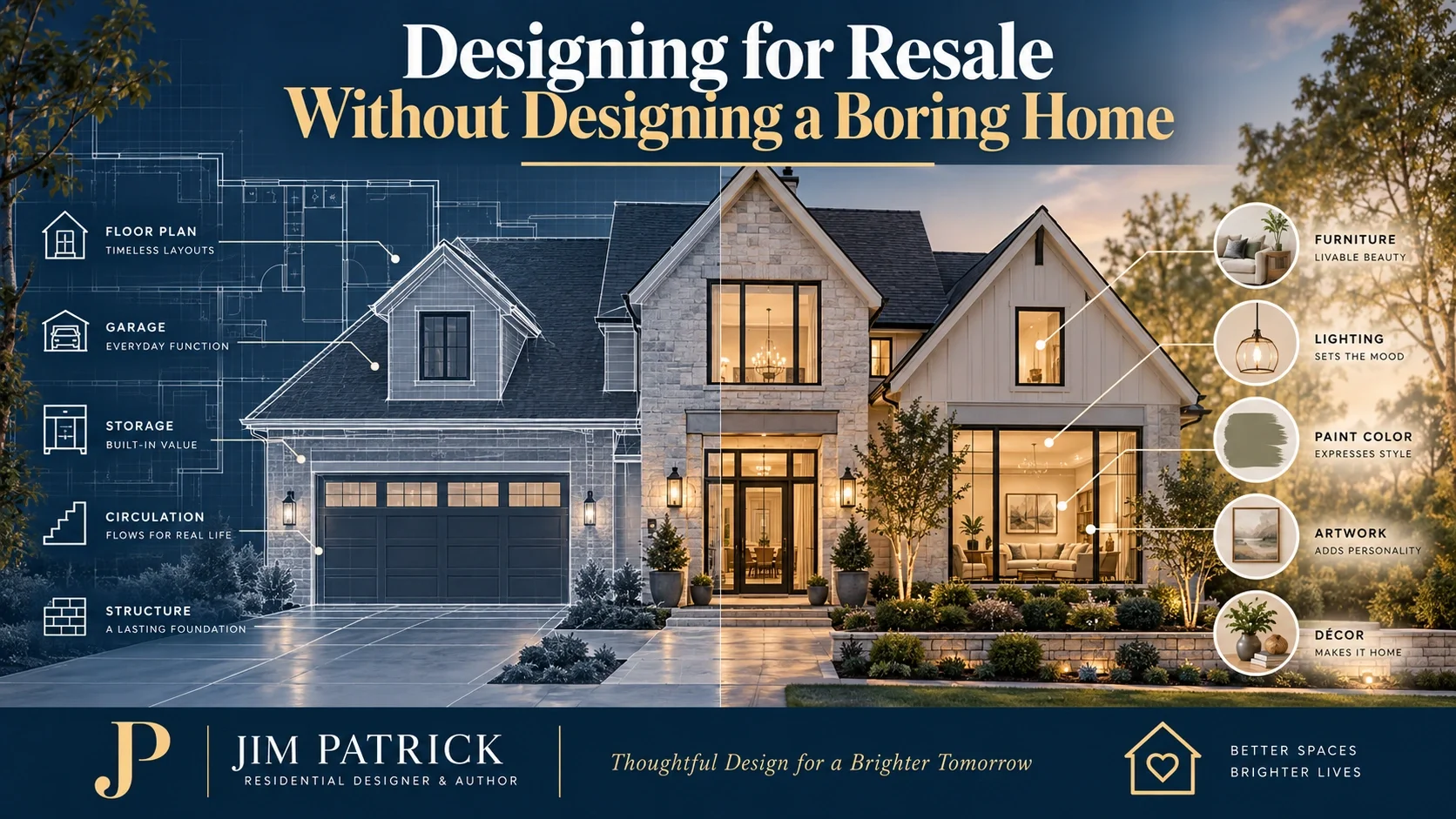
Designing for Resale Without Designing a Boring Home
Estimated Reading Time: 18 Minutes
Category: Future Planning Resale
Published: September 11, 2026
Quick Summary
Mention resale value during the design of a new home and homeowners sometimes react as though you just took all the fun out of the project.
“We're building this for us.”Good.You should.I do not believe you should spend years dreaming about a home, invest a substantial amount of money building it, and then make every decision around some imaginary future buyer.That can produce a house nobody dislikes.It can also produce a house nobody loves.But there is another extreme.Design every permanent part of the home around one very specific moment in your life, one hobby, one trend, or one personal preference, and someday the home may work exceptionally well for you—and very poorly for almost everyone else.That is where thoughtful resale home design comes in.
The goal is not to create a beige house.
The goal is to create a useful house with personality.
A home can have:CharacterInteresting architectureBeautiful materialsPersonal colorsDistinctive roomsSpecial featuresMemorable outdoor spaces
and still maintain broad appeal.The secret is knowing where to personalize aggressively and where to preserve flexibility.
My rule is fairly simple:
Be careful making highly personal decisions expensive to reverse.
Express yourself freely in the layers that are easy to change.Think much harder about the things another owner would need a saw, jackhammer, electrician, plumber, framer, or excavator to undo.That is the balance.Direct Answer: How Do You Design for Resale Without Creating a Boring Home?
Design for resale by making the permanent architecture broadly useful while allowing the replaceable layers of the home to reflect your personality.
Protect long-term flexibility in decisions involving:Floor-plan relationshipsRoom proportionsStorageGarage sizeMain-level livingDoorways and circulationBathroom layoutsKitchen functionNatural lightWindowsOutdoor connectionsMechanical systemsMaintenanceEnergy performance
Then personalize through:PaintFurnitureArtworkLightingHardwareDecorative fixturesAccent materialsSome finish selectionsLandscapingFurnishings and accessories
You are not designing a house for strangers.You are designing a good home that does not unnecessarily prevent someone else from seeing their own life there someday.The best resale-friendly homes usually do not feel designed for resale.
They simply work.
Resale Should Be a Filter—Not the Designer
This is probably the most important distinction in the entire article.I would not begin a new-home design by asking:“What will a future buyer want?”I would begin where I always begin.Who will live here?How do you live?What does your family need?What isn't working in your current home?What is your budget?What does the property allow?What might change later?That is why the right way to start planning your dream home begins with your life rather than a future sales listing.Once we have a design that serves you well, then resale becomes a useful filter.We ask:Is this decision so specific that it unnecessarily limits the home later?
Sometimes the answer is yes.Often it isn't.That is a far healthier way to think about resale.“Resale-Friendly” Does Not Mean “Generic”
This is where I think some homeowners get bad advice.They hear:“Keep everything neutral.”That may be useful advice immediately before listing an existing home.It is not a very inspiring way to design a home you may live in for twenty years.You should enjoy your home.If you love color, use color.If you love dramatic lighting, use it.If you want an interesting fireplace, design one.If you enjoy modern architecture, build modern architecture.If a beautiful outdoor space changes how your family lives, create it.Personality is not the enemy of resale value.Inflexibility is the bigger risk.
The Permanence Test
When evaluating a highly personal choice, ask:
How difficult would this be for someone else to change?
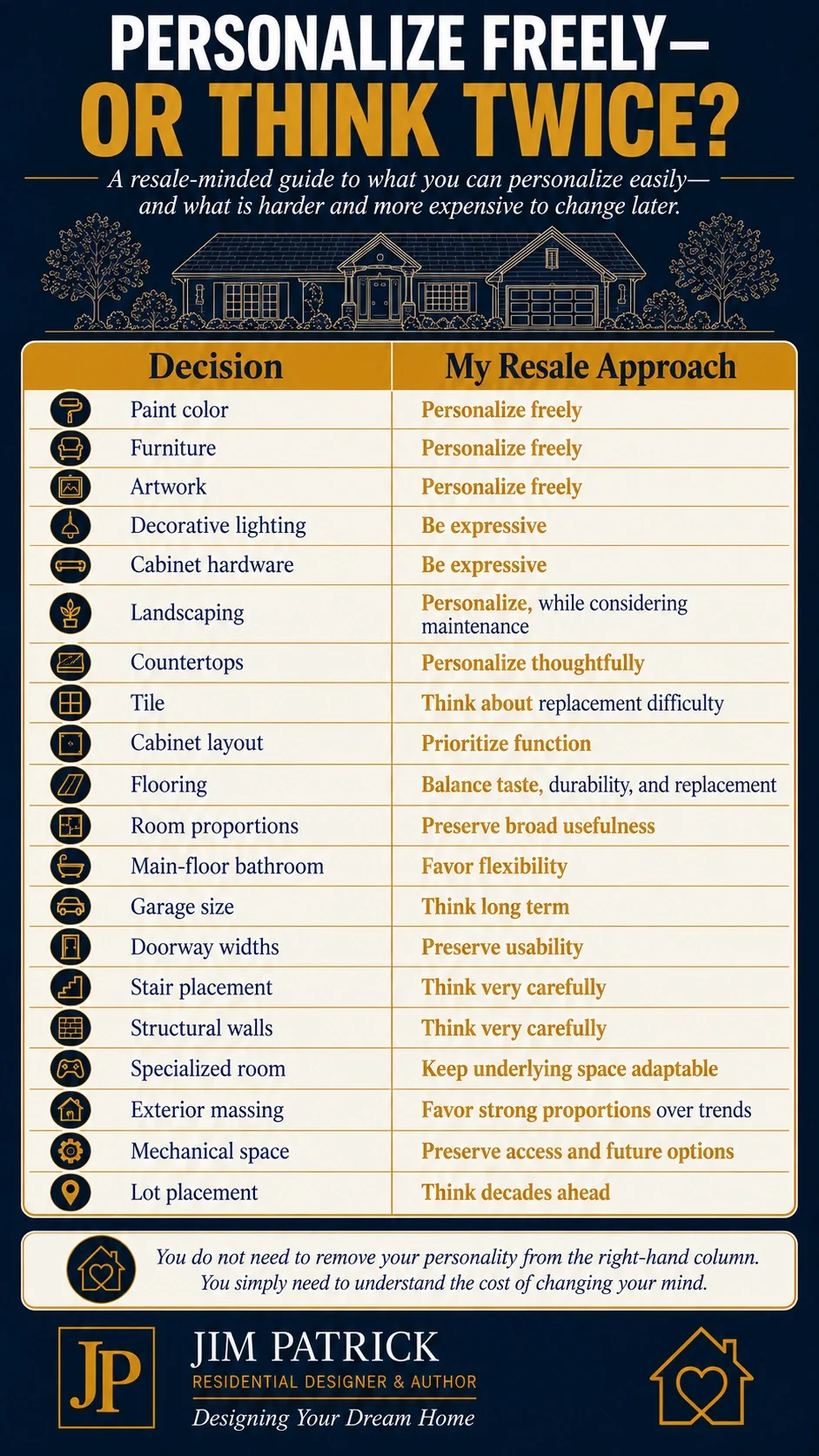
Easy to Change
Paint.Furniture.Artwork.Rugs.Cabinet hardware.Many light fixtures.Decorative accessories.Window treatments.Be bold.Moderately Difficult to Change
Flooring.Countertops.Tile.Plumbing fixtures.Built-in cabinetry.Exterior colors.Think longer.Expensive to Change
Walls.Stairs.Plumbing locations.Room sizes.Foundation.Garage dimensions.Ceiling structure.Major windows.Exterior massing.Mechanical-room size.House placement.Those are the decisions where I become much more cautious.The more permanent the decision, the more useful it should remain.That is one reason Future-Ready Home Design focuses so heavily on preserving options.Build a Good Room Before You Build a Specialized Room
Suppose you love quilting.You want a quilting room.Nothing wrong with that.But instead of designing a room that can only function as a quilting room, perhaps we design:Good dimensions.Useful natural light.Storage.Electrical outlets.A closet.A door for privacy.Nearby bathroom access.Now you have an excellent quilting room.A future owner sees:Bedroom.Office.Craft room.Exercise room.Guest room.That is smart resale design.You did not give up your room.
You gave the room options.
Flexible Rooms Are One of the Best Resale Features You Can Build
I have become a bigger believer in flexible rooms as the years have passed.Families change too quickly for every room to have one permanent job.Today's:Nurserymay become tomorrow's:Office.Then:Guest room.Then:Hobby room.Then:Caregiver room.The room itself did not become outdated.Its job changed.That is why space planning for homes should go beyond room names.Future buyers may not share your hobbies.They may not work from home the way you do.They may have different family structures.A flexible room lets them adapt the home instead of remodel it.That flexibility creates value.My 1991 House Taught Me Something About Resale
In 1991, I built a home for my young family.Like many homes of that era, it included:A formal living room.And a formal dining room.At the time, those were expected features.They looked good on a floor plan.They made the house feel complete.The problem was real life.Our family spent most of its time elsewhere.The kitchen.The family room.The informal spaces.The formal rooms were used far less often.That experience taught me an important lesson.A feature can be considered desirable by the market and still not be particularly useful to the family living there.
Trends change.Expectations change.Lifestyle changes.Today a homeowner might make the opposite mistake by assuming today's open-concept preference, office configuration, technology, or kitchen trend will remain unchanged forever.It won't.That does not mean avoid current ideas.It means distinguish between a temporary fashion and a lasting principle.Useful space tends to survive trends better.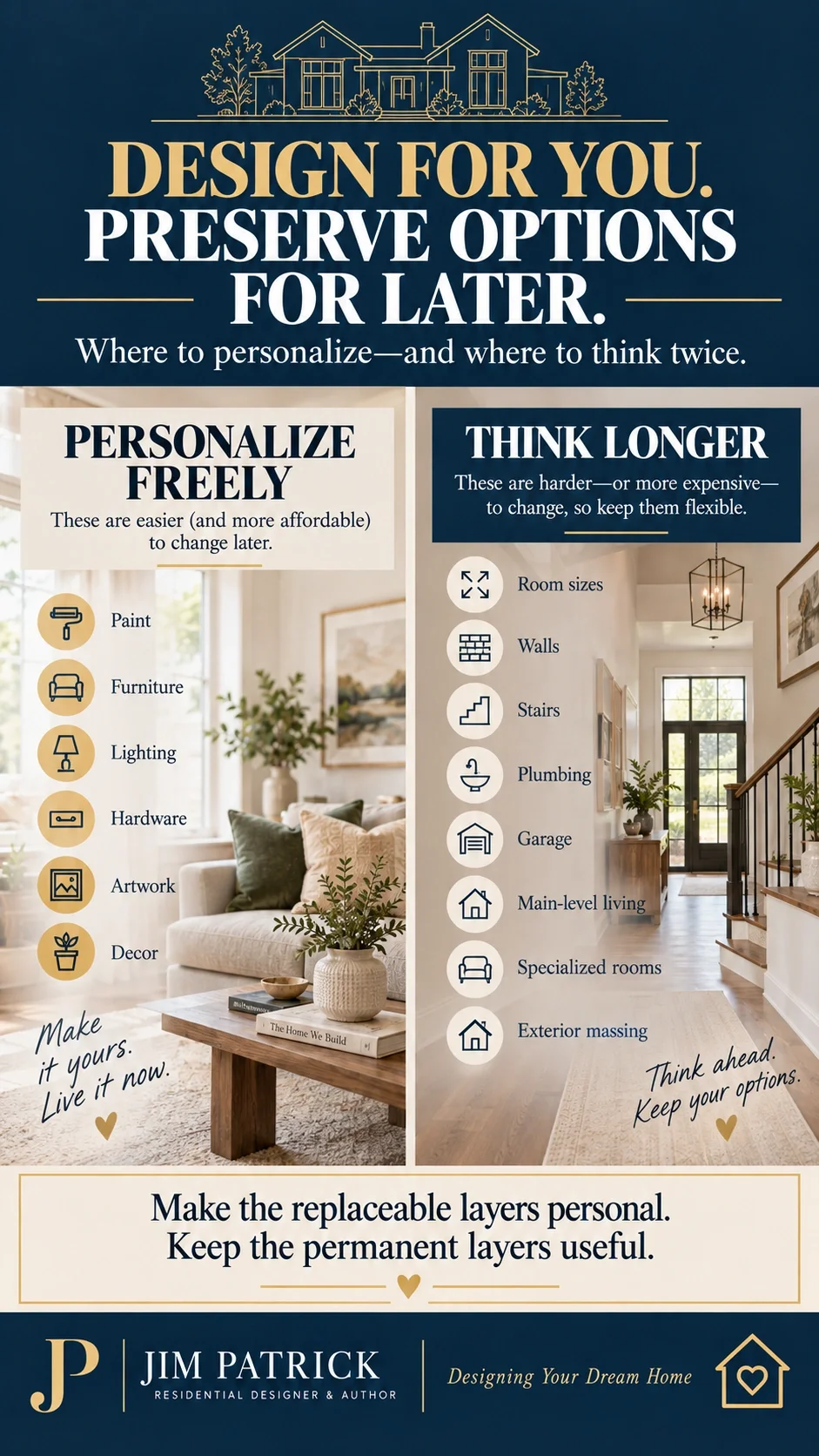
Do Not Confuse Tradition With Resale Value
There is another trap.Sometimes homeowners include a feature because:“Every nice home should have one.”Why?Formal dining room?Maybe.Second living room?Maybe.Oversized foyer?Maybe.Huge bathtub?Maybe.Every one of those could be exactly right for your household.But the words “nice homes have them” are not enough.
Ask how the space will actually be used.The same logic behind How Much House Do You Really Need? applies to resale too.Useful square footage usually has broader appeal than square footage included only to satisfy an expectation.What Buyers Want Changes—What Useful Homes Need Changes Much Less
Specific buyer preferences do move over time.That is one reason I would never design a house around a survey alone.But broad patterns are useful.The National Association of Home Builders' buyer research has repeatedly found interest in practical features such as laundry rooms, garage storage, patios, full baths on the main level, kitchen storage, and energy-related improvements. Their more recent design-trend research has also emphasized buyers wanting homes that feel personal rather than simply following whatever an influencer says is fashionable.That reinforces something I have observed for decades.Practical does not mean boring.
A great laundry room is useful.A good pantry is useful.Garage storage is useful.Outdoor living is useful.Natural light is useful.Those features can still be designed beautifully.For current buyer-preference research, see the National Association of Home Builders' housing design research.A Resale-Friendly Kitchen Does Not Need to Be Boring
The kitchen is one of the places homeowners become most nervous about resale.“Should we choose white cabinets because buyers like white?”Maybe.But I would not begin there.I would begin with the architecture of the kitchen.Does it function?Can two people work comfortably?Is there enough storage?Does the pantry make sense?Can groceries reach the kitchen conveniently?Does the island interfere with circulation?Is there enough counter space?Can people gather without standing in the main work path?Those decisions will probably matter longer than the exact cabinet color.Cabinets can eventually be refinished or replaced.A badly located kitchen inside a poorly organized floor plan is a much larger problem.This is exactly why designing around daily routines matters.First create a kitchen that works.Then make it yours.Personalize the Finish—Not the Dysfunction
That is a phrase worth remembering.Want green cabinets?Fine.Want a dramatic stone backsplash?Maybe that is exactly right for you.Want unusual pendants?Enjoy them.Those selections might not be everyone's choice.But they can be changed.A kitchen with a five-foot traffic bottleneck, inadequate storage, and an island blocking the refrigerator is harder to correct.The architecture should support broad usefulness.The finishes can express personality.Bathrooms Follow the Same Rule
Bathrooms can become highly personal.Freestanding tubs.Wet rooms.Multiple showerheads.Floating vanities.Bold tile.Unusual fixtures.Again, none of those things are automatically bad for resale.I would pay closer attention to:Can the room function comfortably?Is the shower accessible?Is there reasonable storage?Does the bathroom have practical lighting?Can someone use it if mobility changes?Is maintenance reasonable?Are plumbing decisions unusually difficult to reverse?The decorative layer can change.The room's bones are more permanent.Main-Level Living Is Resale Planning Without Looking Like Resale Planning
One of the most useful long-term design strategies is making sure essential living can happen on one level.That might include:KitchenLivingFull bathroomLaundrySleeping space
Maybe that sleeping space is the primary suite.Maybe it begins as an office or guest room.This broadens the number of ways the home can serve people.Young family.Visiting grandparents.Temporary injury.Older homeowner.Future buyer.AARP's HomeFit Guide approaches home usability in much the same way: many features that help older adults also make homes easier for people of different ages and abilities.The important point is that thoughtful accessibility does not have to look institutional.Usually it just looks like a house that is easier to use.Accessibility Can Actually Make a Home More Appealing
Comfortable door widths.Reasonable circulation.A shower that is easy to enter.Good lighting.Minimal thresholds.Lever hardware.A practical main-level bathroom.Those are not “old-person features.”They are good features.I have written before that future-ready design is really about preserving options.Accessibility follows the same principle.You are not predicting who will buy the home.You are simply avoiding unnecessary barriers.Garage Size Has Broader Appeal Than Many Decorative Upgrades
I may be biased because I have watched garages become more important throughout my career.But this is an area where function often has strong broad appeal.Vehicles are larger.People own:Bicycles.Freezers.Tools.Sports equipment.Recreational equipment.Holiday decorations.Workbenches.A garage that barely fits the cars may look fine on move-in day.It can become frustrating quickly.That is why I think a well-planned garage can be a better long-term investment than certain expensive decorative upgrades.And remember:Garage size and garage appearance are two different problems.
My article Why Garage Placement Can Make or Break Curb Appeal explains how to get useful garage space without letting the garage become the entire front elevation.
Storage Is Almost Never a Boring Feature
I have not met many homeowners who complained:“This house has too much useful storage.”Storage supports nearly every stage of life.Children.Hobbies.Work.Guests.Grandchildren.Travel.Seasonal items.Sports.Cleaning supplies.Food.A home with intelligent storage can appeal to many different lifestyles because storage lets the future owner decide what the space supports.But remember:More closets are not automatically better.Storage needs to be in useful places.That is why room relationships and activity-based space planning matter.Natural Light Rarely Feels Generic
Here is another example of broad appeal that does not require boring design.Natural light.Views.Window placement.Connection to outdoors.These can create tremendous personality.The key is doing them intelligently.Windows need to work with:Furniture.Exterior composition.Energy performance.Privacy.Sun.Structure.View.A well-placed window may benefit almost anyone who lives there.That is a much different resale strategy from trying to guess which cabinet color will be fashionable in 2040.Curb Appeal Can Be Distinctive Without Being Trend-Dependent
I absolutely believe the exterior should have character.But I prefer to create character through:Proportion.Roof relationships.Window balance.Entry.Material composition.Garage placement.Depth.Shadow.Scale.Those fundamentals tend to age better than piling decorative trends onto a weak exterior.That is the main message behind Why Curb Appeal Starts Before You Choose a Style.You can build:Modern.Traditional.Contemporary.Craftsman-inspired.Farmhouse-inspired.Regional architecture.The style can be personal.But the proportions still need to work.Good design is not boring simply because it is well proportioned.Be Careful With Exterior Features That Are Expensive to Undo
Trends become riskier as they become structural.A paint trend?Change it.A light fixture?Change it.An unusual roof form requiring extensive framing, flashing, and maintenance?Different conversation.A facade covered with elements that only make sense for one short-lived style?Think longer.A massive permanent architectural feature built around a temporary fashion?I become cautious.That is one reason building material value should be evaluated beyond initial appearance and price.Ask what the feature contributes after the trend fades.Design for the Neighborhood Without Copying the Neighborhood
Resale also exists in context.The same house can be evaluated differently in two different locations.Neighborhoods create expectations around:Size.Garage.Quality.Lot use.Exterior materials.Number of bedrooms.Outdoor spaces.Maintenance.You do not need to copy the house next door.I hope you don't.But dramatically underbuilding or overbuilding relative to the surrounding market deserves thought.That is another reason the property should help shape the home.A house exists in a place.Resale does too.Do Not Build the Most Expensive Feature in the Neighborhood Just Because You Can
This is where personal value and market value separate.Suppose you spend $80,000 creating a highly specialized hobby space.You use it every day for twenty years.Wonderful.It may have been worth every penny.That does not mean the next buyer will pay you $80,000 more for it.And that is okay.Not every dollar spent on a home needs to produce a financial return.Homes create lifestyle value too.The mistake is confusing the two.Personal value is real.
Market value is real.
They are not always the same value.
The Personal Value vs. Market Value Test
Before adding an expensive specialty feature, ask two questions.
Question One
How much value will this add to our life?
Question Two
If a future owner does not want it, can the space easily become something else?
If the first answer is high and the second answer is yes, I am much more comfortable.For example:A well-designed workshop with good dimensions and flexible utilities might someday become:Studio.Garage expansion.Hobby space.Home business.Storage.Exercise area.That is different from a highly specialized space that requires major reconstruction to become anything else.A Home Theater Is Not Automatically a Resale Problem
Let's use another example.You love movies.You want a theater.Fine.The problem is not the theater.The question is:What have we permanently done to the room?Does it still have useful proportions?Could someone remove the theater seats?Could the room become:Family room?Game room?Exercise room?Office?Bedroom where appropriate?If yes, enjoy your theater.Specialized use is less risky when the underlying space remains flexible.
Pools Are Another Good Example
A pool may dramatically improve your life.Someone else may consider it:Maintenance.Insurance.Expense.Or the best part of the property.That depends on:Market.Climate.Neighborhood.Buyer.There is no universal answer.This is where I want homeowners to stop looking for rules like:“Pools add value.”or“Pools hurt resale.”Maybe.Maybe not.Ask whether the pool makes sense for:Your lifestyle.Your climate.Your property.Your neighborhood.Your ownership horizon.And accept that part of its value may simply be the years your family enjoys it.Energy Performance Is Usually Quiet Value
Some of the best long-term features are not visually exciting.Insulation.Air sealing.Efficient windows.Thoughtful HVAC.Good moisture management.These rarely create the emotional reaction of a dramatic kitchen.But they affect:Comfort.Utility bills.Durability.Noise.Ownership costs.The U.S. Department of Energy's building-science resources point to the value of treating efficiency as a whole-home system rather than simply buying one expensive product. Some energy-efficiency programs and research also associate efficient homes with stronger resale performance in certain markets. DOE's Building Science Education resources provide more background.I would not promise a specific resale return.Markets vary.But a comfortable home with manageable operating costs has a pretty broad audience.Maintenance Is a Resale Feature Too
Imagine two beautiful houses.One requires:Frequent exterior painting.Complicated roof maintenance.Hard-to-reach windows.Extensive specialized landscaping.Difficult mechanical access.The other is designed with maintenance in mind.Which one will every buyer prefer?I cannot tell you.But maintenance becomes increasingly important as people get older and as homes age.That is why I want homeowners thinking beyond the final photographs.What does this home ask from its owner every year?That matters.Do Not Permanently Design Around Today's Technology
I have watched this mistake happen repeatedly.Built-in entertainment centers sized around televisions that disappeared.Computer desks designed around old equipment.Telephone niches.Technology closets for systems that became obsolete.Technology changes much faster than architecture.So use it.Enjoy it.Install the smart-home systems you want.But be cautious about making permanent walls and cabinetry dependent upon one generation of technology.My preferred rule is:Build a good room first. Put technology into it second.
That order usually ages better.
Floor-Plan Logic Has Strong Resale Value
I have spent much of this article talking about flexibility, but there is an even simpler test.Does the floor plan make sense?Can visitors find the front door?Can guests find a bathroom?Can groceries get from the garage to the kitchen?Is laundry located reasonably?Do bedrooms have privacy?Is there adequate storage?Can furniture fit?Do major walking paths avoid cutting through activity areas?Those are not trendy features.They are usability.If you have not already done it, use The Floor Plan Walk-Through Test.A logical plan can serve many different owners because good flow is broadly useful.The Buyer Perspective Exercise
Here is one resale exercise I like because it does not require designing your home for anyone else.Finish your plan.Then pretend you have never seen it before.You are a buyer walking through the home twenty years from now.Ask:What is this room?Is that obvious?Where do I put my furniture?Where do I store things?Can I imagine my life here?Which room feels overly specialized?Does anything require an explanation?Does the garage work?Would the maintenance concern me?Could I live primarily on one level if needed?Would the home still work if my family were different from yours?This exercise does not mean changing everything.It simply reveals where flexibility may be disappearing.A Designer's Experience: The Home That Fit More Than One Family
Years ago, I worked with homeowners who were considering several highly specialized features.They liked them.There were good reasons behind them.But the features were specific enough that we spent time discussing the long-term implications.Eventually I asked them a question:“Are you building this home only for yourselves, or are you building a home that could someday appeal to someone else as well?”
The question did not cause them to abandon their personality.That was not the goal.They still included features they cared about.They still made the home theirs.But we also protected flexibility where it mattered.Years later, circumstances changed.The house went on the market.And it sold quickly.I do not believe the lesson was:“Design everything for the buyer.”The lesson was:The house worked for the people who built it—and it could work for somebody else.
That is the sweet spot.Your manuscript describes that experience in exactly those terms: personalization remained, but broader usefulness was preserved.The Two-Layer Resale Strategy
If you remember nothing else from this article, remember this.
Layer One: Protect the Bones
Be thoughtful with:Lot placementFoundationFloor planStairsRoom proportionsMain-level livingDoorwaysBathroom layoutStorageGarageNatural lightRoof massingMechanical accessEnergy performance
These are difficult or expensive to change.Layer Two: Make the Home Yours
Enjoy:ColorFurnitureLightingHardwareArtDecorative finishesAccessoriesLandscapingPersonal collectionsStyle
Those are the layers that give the house personality.This approach allows the home to be memorable without making every future change a remodeling project.Personalize Freely—or Think Twice?
How I Would Think Through This With a Client
If you were sitting across the desk from me and said:“Jim, we want to build exactly what we want. We don't care about resale.”I would probably say:Good.Tell me what you want.Then, as we worked through it, I would begin asking questions.How long do you realistically expect to stay?
Maybe forever.
Maybe not.
Is this feature primarily personal?
Nothing wrong with that.
What does it cost?
What does it cost to undo?
Does the space have another logical use?
Are we sacrificing daily function to create it?
Does it make the house harder for you to live in?
Is the decision permanent—or replaceable?
Does it make sense in this neighborhood?
Does it increase maintenance?
Does it eliminate future accessibility?
Could another person understand the room without us explaining it?
Does the feature improve your life enough to justify the risk?
That final question matters.Because sometimes the answer is absolutely yes.Build it.You are allowed to enjoy your own home.Resale is not supposed to remove joy from the project.It is supposed to keep you from accidentally limiting your future.What This Decision Affects
Floor Plan
Highly specialized layouts may reduce flexibility.
Budget
Personal features may create lifestyle value without equivalent market value.
Home Size
Occasional-use specialty rooms add permanent construction and ownership costs.
Storage
Useful storage tends to support many different households.
Accessibility
Broader usability can serve current owners and future buyers.
Garage
Practical dimensions and storage provide flexible usefulness.
Maintenance
Future owners evaluate the work a property requires.
Energy
Operating cost and comfort continue long after finish trends change.
Exterior
Strong proportions usually age better than decoration-dependent design.
Materials
Some personal finishes are easy to change; others are expensive.
Technology
Permanent architecture should outlast individual devices.
Resale
The larger the group of people who can comfortably imagine living in the home, the more options you may preserve.
Common Resale Home Design Mistakes
Mistake 1: Designing Entirely for the Future Buyer
You are the one living there now.
Mistake 2: Ignoring Resale Because You Plan to Stay Forever
Plans change.
Mistake 3: Making Every Surface Neutral
Personality can live in replaceable layers.
Mistake 4: Building Highly Specialized Permanent Rooms
Keep the underlying space adaptable.
Mistake 5: Following Trends Too Literally
Trends change faster than houses.
Mistake 6: Confusing Personal Value With Market Value
Both are legitimate—but they are different.
Mistake 7: Sacrificing Function for Appearance
Good function usually has broad appeal.
Mistake 8: Underestimating Storage
Storage is lifestyle infrastructure.
Mistake 9: Designing the Garage Only Around Today's Cars
Future needs change.
Mistake 10: Ignoring Main-Level Living
Flexibility broadens usability.
Mistake 11: Overbuilding for the Neighborhood
Market context matters.
Mistake 12: Assuming Every Upgrade Comes Back at Resale
It may not.
Mistake 13: Designing Around Technology
Technology will change before the walls do.
Mistake 14: Building Maintenance Into Every Exterior Decision
Think about ownership twenty years later.
Mistake 15: Making the House So Generic That You Do Not Love It
That misses the point too.
Questions I Would Ask Before Making a Highly Personal Design Decision
How often will we use this?How much will it improve daily life?How long do we expect to own the home?Is this a permanent architectural decision?Could it be changed cosmetically instead?How much does it cost now?How much might it cost to undo?Does it affect structure?Plumbing?Electrical?Windows?HVAC?Does it make the room less flexible?Could this room serve another purpose?Would another family understand the layout?Does the feature require unusual maintenance?Is it dependent on current technology?Is it dependent on a short-lived trend?Does it make sense for the neighborhood?Does it sacrifice storage?Does it sacrifice garage space?Does it reduce accessibility?Does it improve natural light?Does it improve comfort?Does it make the floor plan work better?Is the feature valuable only to us?If so, are we comfortable with that?Could a future buyer remove it reasonably?Are we mistaking price for resale value?Would we still make this decision if resale were never mentioned?
That last question is important too.Because the home still needs to be yours.Resale Home Design Checklist
Before finalizing the design:Home works exceptionally well for current ownersFloor plan is logicalRoom sizes are practicalFurniture fitsStorage is intentionalGarage meets real needsMain-level living has been consideredAccessibility is reasonably supportedFlexible room identifiedSpecialized rooms can adaptNatural light is prioritizedExterior proportions are strongGarage does not overpower curb appealMaintenance is understoodEnergy performance consideredMechanical systems remain serviceablePermanent architecture is not overly trend-dependentTechnology can change without major reconstructionHighly personal finishes are mostly replaceableNeighborhood expectations consideredPersonal value and market value separatedBuyer-perspective walkthrough completedFuture lifestyle changes consideredResale used as a filter—not as the designer
If that list works, the home does not need to be boring.It needs to be good.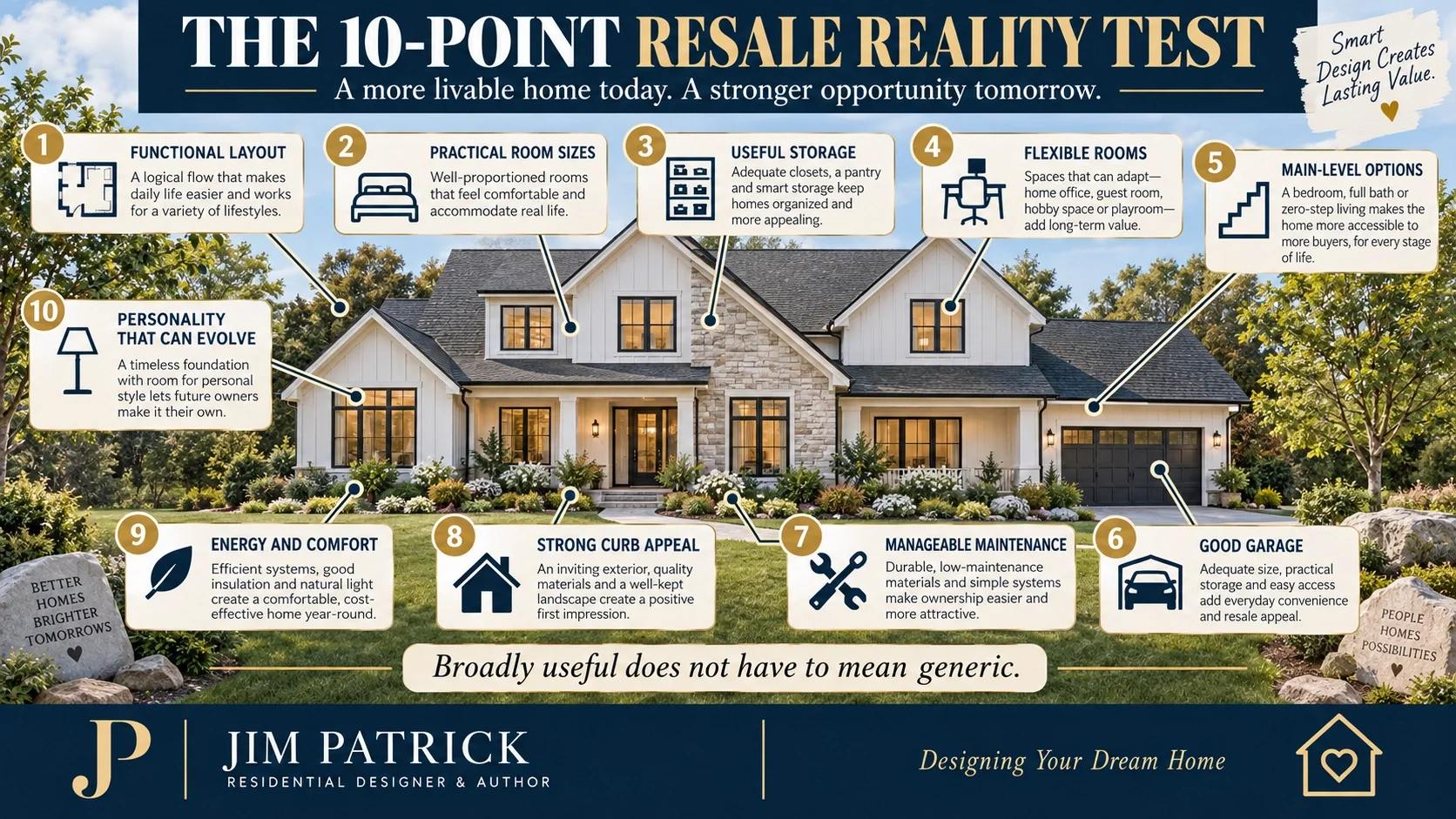
Key Takeaways
Designing for resale does not mean designing a generic house.The home should first serve the people building it.Resale should be used as a filter, not the starting point.Personalize aggressively where changes are easy.Think harder where choices are structural or expensive to reverse.Flexible rooms create options.Main-level living can improve current usability and future appeal.Storage, garage space, natural light, comfort, and logical circulation are broadly useful features.Specialty rooms are less risky when the underlying space can adapt.Personal value and market value are not the same thing.A feature does not have to produce a financial return to be worthwhile.Trends are safest in replaceable layers.Permanent architecture should be built around longer-lasting principles.Energy performance and reasonable maintenance can matter long after finishes change.A home can be distinctive and still make sense to another family.The sweet spot is a house that works beautifully for you—and does not prevent someone else from making it theirs someday.
Designer's Advice
If you were building only for resale, I would tell you not to build.There would be very little point in creating a dream home you were afraid to personalize.Your home should say something about you.It should support your family.Your hobbies.Your routines.Your taste.Your goals.Your future.But there is a difference between personalization and entrapment.Paint the room the color you love.Hang the art.Choose the lighting.Create the outdoor space.Build the workshop if you will use it.Enjoy the house.Just think carefully before making a permanent part of the architecture serve only one narrow purpose.After nearly fifty years in residential design, I have seen trends come and go.Formal living rooms.Entertainment centers.Computer rooms.Different kitchens.Different roofs.Different colors.Different materials.The details change.The strongest homes keep doing a few things well.They function.They adapt.They provide storage.They are comfortable.They are maintainable.They make sense.And people can imagine living in them.That is why I do not think good resale design is about guessing what the next owner will want.You cannot know.It is about giving the home enough flexibility that the next owner still has choices.
And here's the part I like best:Those same decisions usually make the house better for you too.So build a home with personality.Build something you enjoy driving up to.Build rooms your family uses.Choose finishes you love.Make the home yours.Just make sure the personality lives in the home—rather than trapping the home inside the personality.Related Articles
Continue planning with:Future-Ready Home Design: What to Think About Before You BuildDesigning a Home You Will Still Love Twenty Years From NowHow Much House Do You Really Need?The Hidden Costs of Building a Larger HomeWhy Room Names Are Not Enough When Planning a HomeDesign Around Daily Routines, Not Special OccasionsWhy Garage Placement Can Make or Break Curb AppealWhy Curb Appeal Starts Before You Choose a StyleThe Difference Between Cheap Materials and Smart ValueThe Floor Plan Walk-Through Test Every Homeowner Should Use
Related Video
If you are earlier in the planning process, watch 10 Questions to Answer Before Building a House.It will help you establish the bigger family, budget, property, floor-plan, and future questions before you become committed to individual design features.Have More Home-Building Questions?
I have also created a Home Building FAQ with 50 questions to ask before you build, with links into the articles and videos that explore each subject in greater depth.
Build for Yourself—Without Closing Tomorrow's Doors
My free Dream Home Planning Checklist will help you think through your family, lifestyle, budget, property, space requirements, garage, storage, systems, accessibility, future needs, and long-term priorities before the design gets too far ahead.Download the Free 24-Page Dream Home Planning Checklist
The goal is not to build a house everyone would choose.The goal is to build the right house for you—without unnecessarily making it the wrong house for everyone else.
Frequently Asked Questions About Resale Home Design
Should I Design My New Home Around Resale Value?
No.Your home should first serve your family, lifestyle, budget, property, and future.Resale is better used as a filter for highly permanent or specialized decisions rather than the primary driver of the entire design.Does a Resale-Friendly House Need Neutral Finishes?
No.Paint, furniture, hardware, lighting, décor, and many finishes can express considerable personality.Be more cautious when highly personal choices become structural, difficult, or expensive to replace.What Home Features Usually Have Broad Appeal?
Broadly useful features often include logical floor plans, adequate storage, practical room sizes, functional kitchens, useful laundry space, garages with storage, natural light, outdoor living, comfortable circulation, and adaptable rooms.Buyer preferences still vary by location and market.Are Flexible Rooms Better for Resale?
They can be.A room capable of functioning as a bedroom, office, guest room, exercise room, hobby space, or other use gives both current and future owners more options.Should I Avoid Specialty Rooms?
Not necessarily.Build spaces that improve your life.Where practical, design the room so the underlying space can serve another use later without major reconstruction.Does Accessibility Help Resale?
Features that make a home easier to use across different ages and mobility levels can broaden the range of people the home can serve.Main-level living, comfortable circulation, practical bathrooms, good lighting, and easier entries often improve usability even before accessibility becomes a concern.Is a Bigger Home Better for Resale?
Not automatically.Additional square footage costs money to build, maintain, heat, cool, furnish, and update.A well-planned smaller home may appeal more than a larger home with poorly allocated or rarely used space.Do Expensive Upgrades Increase Resale Value?
Not necessarily by the amount they cost.Some improvements create personal enjoyment, maintenance savings, comfort, or durability without producing an equivalent increase in sales price.Personal value and market value should be evaluated separately.How Much Should Neighborhood Expectations Influence Design?
Enough to understand the market context, but not enough to make every house look alike.Size, quality, garage expectations, lot use, and major features may influence future marketability, while architecture and finishes can still have personality.Should I Avoid Trends?
No.Trends can make a home current and enjoyable.Use more caution when a trend becomes an expensive permanent architectural decision.Replaceable layers are safer places to experiment.Does Energy Efficiency Matter for Resale?
It can.Efficient windows, insulation, air sealing, HVAC design, and other improvements may improve comfort and operating costs, which can remain useful regardless of changing decorative trends.Actual resale impact varies by market.What Is the Best Resale Design Rule?
Make the permanent parts broadly useful and the replaceable parts personally yours.
That creates a home with personality while preserving future flexibility.