
The Difference Between Cheap Materials and Smart Value

Estimated Reading Time: 18 Minutes
Category: Building Materials Structure
Published: September 4, 2026
Quick Summary
One of the easiest ways to get into trouble while building a home is to assume that every lower-priced material is cheap.It isn't.And one of the easiest ways to overspend is to assume that every higher-priced material is better.It isn't either.After spending most of my life around residential construction and building materials, I have learned to separate price from value.A low-priced product can be an excellent value when it:Performs the job correctlyFits the climateWorks with the surrounding constructionHas a proven service historyIs installed correctlyRequires reasonable maintenanceCan be repairedIs readily availableDoes not create unnecessary complications elsewhere
A more expensive product can also be an excellent value when the additional investment meaningfully improves:DurabilityWater managementEnergy performanceComfortMaintenanceStructural performanceService lifeRepairabilityDaily use
The question is not:Which material costs less?
And it is not:
Which material costs more?
The better question is:
What am I actually receiving for the money I am spending?
That is the difference between cheap materials and smart building material value.
Direct Answer: What Does Building Material Value Really Mean?
Building material value is the relationship between what a product costs and what it delivers over the period you expect to own and maintain the home.
A useful value comparison should consider more than purchase price.It should consider:Initial costInstallation costExpected service lifeMaintenanceRepair costsReplacement costsEnergy performance where applicableDurabilityAvailability of replacement parts or matching materialsInstallation requirementsCompatibility with surrounding materialsClimate suitabilityWarranty coverageHow long you expect to own the home
A product that costs 20 percent less today but requires significantly more maintenance or earlier replacement may not be the less expensive choice.But neither should you automatically pay 40 percent more for a product simply because someone labels it premium.
Smart value lives somewhere between those two mistakes.
The Cheapest Product Is Not Always the Least Expensive Product
This is one of the first lessons I learned in the building-materials business.There is a difference between:Purchase price
and
Cost of ownership.
Imagine two products.Product A costs less today.Product B costs more.If Product A performs exactly as well, lasts just as long, requires similar maintenance, and can be installed correctly by the people building your home, then Product A may be the smarter value.Spend less.Get the performance you need.That is not being cheap.That is being smart.Now change the situation.Product A requires more maintenance.It is more difficult to repair.It may need replacement sooner.It is less appropriate for the climate.Or the installer has little experience with it.Product B costs more but avoids those problems.Now the lower purchase price begins becoming less meaningful.This is the concept behind life-cycle cost.
The National Institute of Standards and Technology has long used life-cycle economic analysis to compare construction alternatives rather than looking only at acquisition cost. The basic principle is useful for homeowners too: consider costs that occur throughout the useful life of the product, not only what appears on today's estimate. Learn more about life-cycle cost analysis from NIST.You do not need a spreadsheet containing thirty years of financial projections for every piece of trim in the house.You simply need to start asking a better question:What does this choice cost me to own?
Smart Value Does Not Mean Buying the Cheapest Thing That Will Work
There is another extreme.Someone may say:"Why would I spend more? The cheaper one meets code."Code compliance matters.But minimum compliance and best value are not automatically the same thing.Building codes need minimum standards.Homeowners are making ownership decisions.Those are related conversations, but they are not identical.You may decide that the basic material is perfectly adequate.That can be a completely reasonable decision.But make it because you understand what you are buying.Not because the price column was smaller.Smart Value Also Does Not Mean Upgrading Everything
This may be even more important.If I gave you an unlimited budget, I could find ways to upgrade almost every product in a house.Better windows.More expensive roofing.More insulation.Higher-grade siding.More elaborate flooring.Premium cabinetry.Specialty structural products.Higher-performance mechanical equipment.More expensive fixtures.Where does it stop?Most homeowners do not have unlimited budgets.They have a pool of money.Every dollar spent in one place is unavailable somewhere else.So the real goal is not:Buy the best of everything.
The goal is:
Spend more where the additional investment solves an important problem or produces a benefit you will continue receiving.
That is why I encourage homeowners first to understand how to choose building materials for a house.There is no universally best product.There is only a better or worse fit for a particular home.Growing Up in the Building Materials Business Changed How I Look at Products
My relationship with building materials began long before residential design became the largest part of my career.I grew up around a family building-materials business.Over the years, I worked around:HVAC equipment.Plumbing products.Floor coverings.Windows.Doors.Structural materials.Concrete.And countless other products that eventually became parts of people's homes.When you spend enough years around materials, something interesting happens.You get to see them twice.You see them when they are new.Everything looks good then.Fresh siding.New roofing.New windows.New flooring.New equipment.And then, years later, you see some of those products again.That is where the real education begins.How did it age?Did it need constant maintenance?Did it fade?Crack?Warp?Leak?Wear?Could it be repaired?Could you still get replacement parts?Did the homeowner remain satisfied?Was the original installation the real problem?That second look teaches you something the sample board cannot.Almost every material can look good on installation day.
Long-term value reveals itself later.
Price, Quality, and Value Are Three Different Things
I think homeowners sometimes use these words interchangeably.
They should not.
Price
What you pay.
Quality
How well the material is manufactured and how consistently it meets its intended performance expectations.
Value
How well that product's cost and performance match your particular needs.A high-quality product can still be poor value for your project.Imagine spending substantially more for a feature that provides almost no meaningful advantage in your application.Excellent product.Wrong use of money.On the other hand, a relatively ordinary product may be outstanding value because:It performs reliably.Trades understand it.Replacement parts are available.It handles the local climate.Maintenance is reasonable.And the price leaves budget available for higher-priority areas.That is smart value.Use a Life-Cycle Cost Lens
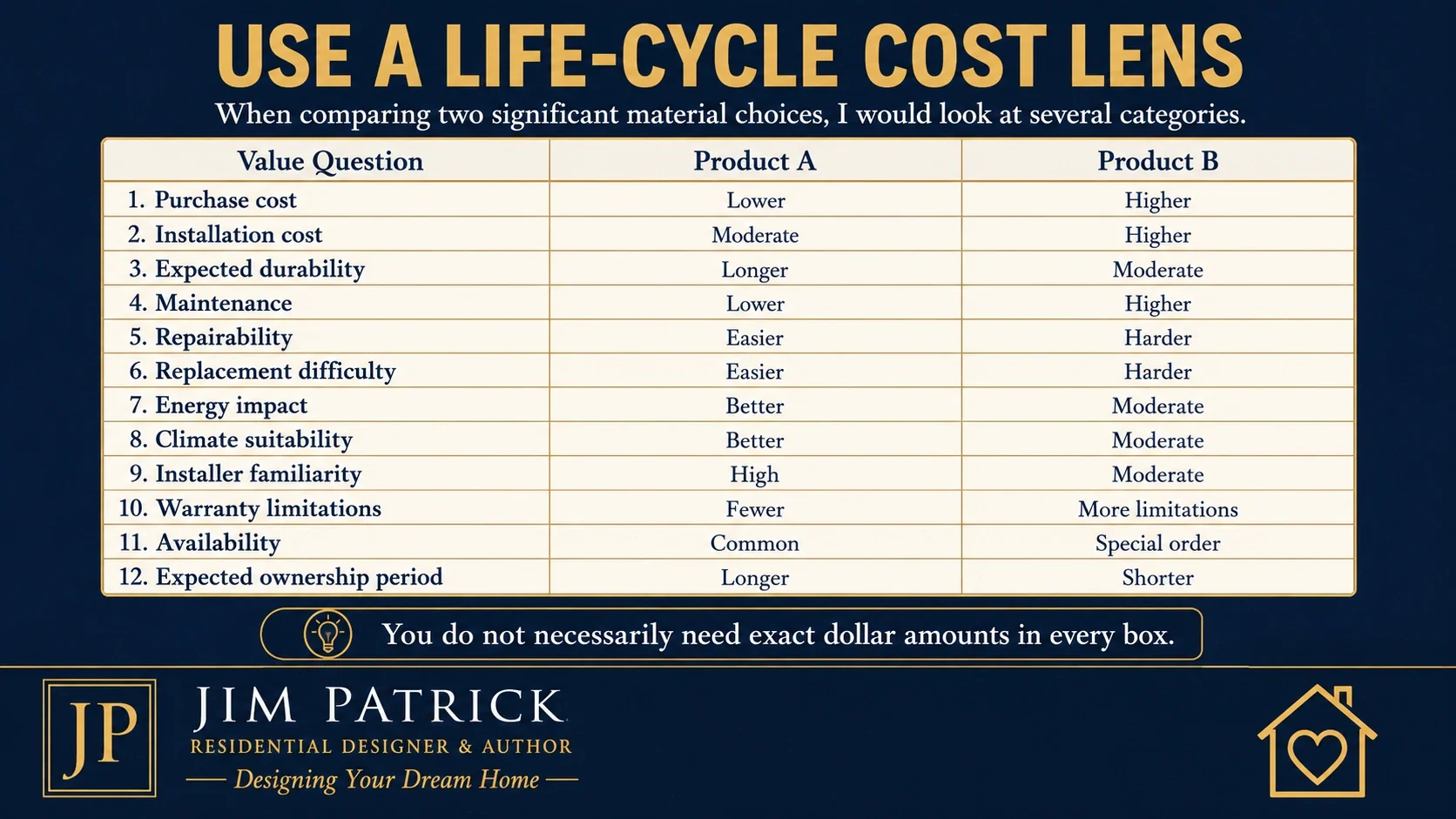
When comparing two significant material choices, I would look at several categories.You do not necessarily need exact dollar amounts in every box.Even:Better
Same
Worse
can reveal a lot.
Where I Am Usually More Cautious About Cutting Cost
Not every material deserves the same budget priority.
I become especially cautious when the material is:
Difficult to Replace
Foundation components.Structural systems.Buried utilities.Waterproofing.Flashing.Subfloor.Wall assemblies.Insulation inside closed walls.Anything you need to tear other parts of the home apart to reach.Responsible for Managing Water
Roofing systems.Flashing.Foundation waterproofing.Drainage materials.Window and door flashing.Weather-resistive barriers.Water is persistent.Failures can affect much more than the product itself.Responsible for Structural Performance
Beams.Headers.Engineered floor systems.Roof systems.Connectors.Foundation reinforcement.Those decisions belong with the appropriate design, engineering, building, and code professionals.Responsible for Daily Comfort
Windows.Insulation.Air sealing.HVAC-related construction.Ventilation.Those systems affect the way you experience the home every day.This is also why some of the most important building-material costs are hidden behind the finished surfaces.Visitors may never compliment your flashing.That does not make it unimportant.Spend Carefully Where Failure Creates a Chain Reaction
Here is another way I think about value.
Ask:
If this product fails, what else gets damaged?
Suppose a decorative cabinet knob fails.Replace the knob.Annoying.Not catastrophic.Now suppose poor water management around an exterior opening allows water into the wall.Potentially different story.Insulation.Sheathing.Framing.Drywall.Paint.Flooring.Trim.Maybe mold.One failure can affect several systems.That is why I assign higher value to some hidden materials than homeowners initially expect.The risk is larger than the price of the individual component.Installation Can Matter as Much as the Product
This is where material comparisons can become misleading.Product A may test better than Product B.But who is installing it?Has the crew used it before?Does it require a special installation method?Does it need special flashing?Fasteners?Adhesives?Clearances?Tools?Preparation?Will everyone following that trade understand how their work connects to it?I have seen excellent materials perform poorly because the installation was poor.I have also seen relatively ordinary materials perform remarkably well because they were correctly designed, detailed, installed, and maintained.That lesson appears repeatedly in Choosing Building Materials for a House.Product matters.
Workmanship matters too.
Sometimes paying more for a complicated material your local installers do not understand is actually a step backward.
The Material and the Installer Should Be Evaluated Together
Before selecting a major product, ask:Who installs it?How many times have they installed it?Are they comfortable with it?Is manufacturer training available?Does warranty coverage depend on particular installation requirements?Can the surrounding trades coordinate with it?Are repair materials locally available?Who services it later?That is smart-value thinking.You are not buying a box of material.You are buying a completed result.Climate Can Turn a Good Value Into a Bad Value
A material can have an excellent reputation and still be wrong for your project.I spent most of my professional career dealing with homes in the Midwest and now live in South Texas.Those are very different environments.Cold.Snow.Freeze-thaw cycles.Versus:Heat.Strong sun.High cooling loads.Humidity.Different climates put different demands on buildings.The U.S. Department of Energy divides the country into climate regions specifically because appropriate building practices vary with temperature and moisture conditions. DOE's climate-zone guidance explains how regional conditions influence residential building strategies.Windows are an easy example.ENERGY STAR's current window, door, and skylight criteria use climate-specific performance requirements rather than one national performance target. ENERGY STAR provides climate-specific guidance for selecting windows, doors, and skylights.That teaches a broader material lesson:Good value is regional.
Do not choose a product because somebody in another climate loves it.
Ask whether it fits yours.
Insulation Is Another Good Example
Homeowners sometimes compare insulation by:Price per square foot.Or thickness.Those numbers alone are incomplete.The job of the insulation depends on:Climate.Assembly.R-value.Air movement.Moisture strategy.Installation quality.Location within the building envelope.The Department of Energy notes that insulation requirements and useful R-values vary substantially by climate zone and assembly. DOE's insulation guidance provides climate-based examples.That does not mean you should automatically install the highest R-value you can buy.It means you should understand what performance you are purchasing.Cheap Windows Can Be Expensive Windows
I am not talking about a brand.I am talking about the way homeowners sometimes evaluate them.Imagine comparing windows based only on unit price.That misses:Glass performance.Air leakage.Operation.Hardware.Frame construction.Installation.Flashing.Water management.Availability of parts.Warranty.Local service.Climate suitability.Window size.Orientation.Sun exposure.A cheaper window that performs adequately for the house may be excellent value.A more expensive window that significantly improves comfort or performance may also be excellent value.But a premium window poorly installed?That may be expensive disappointment.Again:Product plus application plus installation.Roofing Is More Than Shingles
The same principle applies above your head.Homeowners may compare roofing materials by dollars per square.I would also want to know about:Roof pitch.Complexity.Valleys.Penetrations.Underlayment.Flashing.Ventilation.Installation.Weather exposure.Maintenance.A modest roof material on a simple, well-drained, properly detailed roof may provide excellent value.An expensive roofing product on an unnecessarily complicated roof with poor detailing may not.Design creates value too.That is why a buildable house plan needs to coordinate far more than appearance.Exterior Materials Have a Maintenance Story
Every exterior material has one.Painting.Cleaning.Sealing.Caulking.Repair.Replacement.Color fading.Impact damage.Moisture exposure.Insect exposure.Sun exposure.There is no perfect product.A low-maintenance material may cost more.That additional cost may be worth every dollar to one homeowner.Another homeowner may happily accept periodic maintenance because they strongly prefer another material's appearance.Neither is automatically wrong.Value depends on the owner.Ask yourself:What maintenance do I want to perform twenty years from now?
Not only next year.
Maintenance Is Labor—Even When You Do It Yourself
There is another mistake in life-cycle calculations.Homeowners sometimes say:"That maintenance doesn't cost me anything. I'll do it myself."Your time still has value.Your Saturday still exists.Ladders still need to be climbed.Materials still need to be purchased.Eventually you may decide you no longer want to do that work yourself.Then maintenance becomes a labor bill.Reduced maintenance can therefore have value even when the savings are difficult to calculate precisely.Repairability Is an Underrated Form of Value
Suppose two flooring products have similar durability.One can be repaired one section at a time.The other requires replacing a much larger area when damaged.That difference matters.Think about repairability with:Siding.Roofing.Flooring.Trim.Windows.Doors.Fixtures.Cabinet components.Mechanical equipment.Ask:Can one damaged piece be replaced?Can I buy a match ten years from now?Does the finish age in a way that makes patching obvious?Does the entire assembly have to come apart?A product's repair story can matter as much as its replacement story.Availability Matters More Than Homeowners Expect
There is value in common, proven products.Not because common automatically means best.Because availability can matter.What happens if you need three pieces of matching siding in twelve years?A replacement roof accessory?Window hardware?Cabinet hinge?Flooring?Trim profile?A highly specialized material may look wonderful today.But if the manufacturer disappears or the line changes, repairs can become difficult.That does not mean avoid unique products.It means acknowledge the tradeoff.Do Not Let a Warranty Choose the Product for You
Homeowners understandably like long warranties.Twenty-five years.Thirty years.Lifetime.Those words sound reassuring.But a warranty needs to be read.What does it actually cover?Product only?Labor?Original owner only?Is it transferable?Is coverage prorated?What installation requirements apply?What maintenance is required?What is excluded?What does "lifetime" mean in the document?The Federal Trade Commission recommends reading warranty coverage, duration, exclusions, repair procedures, and responsibilities rather than assuming the existence of a warranty guarantees comprehensive protection. FTC consumer guidance explains what to look for in written warranties.A long warranty can be valuable.It is not a substitute for a good product, correct application, or correct installation.A Higher Price Can Sometimes Be Paying for the Wrong Thing
Suppose Product B costs substantially more than Product A.Ask:Why?Better raw materials?Better manufacturing?Better performance?Longer life?Lower maintenance?Better warranty?Better finish?Brand positioning?Marketing?Aesthetic exclusivity?Dealer structure?Some of those things may matter to you.Some may not.The word premium does not tell you which one you are buying.
Where Visible Upgrades Can Become Budget Traps
Homeowners naturally gravitate toward materials they can touch and see.Countertops.Flooring.Cabinets.Exterior finishes.Fixtures.That is part of the fun of building.But imagine spending $20,000 of additional budget on visible upgrades while cutting:Insulation.Window performance.Drainage.Foundation protection.Mechanical access.Garage size.Useful storage.Would that produce the best home?Maybe.But I would want to ask some questions first.This is why understanding your priorities before the design becomes fixed matters.The best budget does not spread money evenly.It puts money where it creates the greatest value.Hidden Materials Often Deserve More Respect
Some of the most important materials in the house disappear.Concrete reinforcement.Structural connectors.Headers.Subfloor adhesives.Flashing.Weather barriers.Foundation drainage.Insulation.Air-sealing materials.Waterproofing.Truss connections.You may never see them after move-in.But those materials can influence:Structure.Water control.Comfort.Durability.Noise.Maintenance.That is why I wrote Materials That Affect the Cost of a Home Before You Ever See Them.Beautiful finishes attract attention.Hidden materials often protect the investment.Moisture Changes the Value Equation
Water deserves special attention because moisture-related problems frequently involve more than one product.The Building America Solution Center points out that materials exposed to excessive moisture during construction should be protected and allowed to dry appropriately before assemblies are enclosed; trapped moisture can contribute to mold and deterioration. Read the Building America moisture guidance.That illustrates something important:The best-value lumber still needs to be handled properly.The best-value insulation still needs a dry assembly.The best-value siding still needs good water management behind it.The best-value window still needs correct flashing.Material value does not exist independently of the house.The House Is a System
This is one of the themes I keep returning to.A home is not a pile of products.Change one part and you can affect another.Window choice affects:Rough openings.Headers.Flashing.Wall insulation.Exterior trim.Interior trim.Heating and cooling.Natural light.Exterior appearance.Floor-system choice can affect:Spans.Beams.Ductwork.Plumbing.Stairs.Ceilings.A siding choice may affect:Wall preparation.Water management.Trim.Thickness.Flashing.Labor.Maintenance.That is why value cannot always be evaluated product by product.Sometimes Product B costs $1,500 more but saves $2,000 somewhere else.Sometimes a "cheap" selection creates extra labor that erases the material savings.Ask about the complete assembly.Smart Value Can Mean Spending Less
I want to emphasize this because I do not want this article to become:"Jim says buy expensive materials."I don't.There are places where the basic option is exactly what I would choose.Maybe the upgrade provides little real-world advantage.Maybe the standard product is well proven.Maybe it is easier to repair.Maybe local trades install it exceptionally well.Maybe you plan to own the home for seven years instead of forty.Maybe the money is more valuable somewhere else.Saving $3,000 on a material that does exactly what you need can be an excellent decision.Use that $3,000 for:Better windows.More useful storage.Better garage space.Improved insulation.A better shower.Or keep the money.Smart value sometimes means saying no to the upgrade.
Smart Value Can Mean Spending More
The reverse is true too.Perhaps the added cost:Eliminates repeated maintenance.Improves comfort every day.Extends service life substantially.Improves water management.Reduces energy loss.Makes repairs much easier.Better fits severe local weather.Improves structural performance.Those benefits may justify the additional investment.Again:Understand what the dollars buy.Think About How Long You Expect to Own the Home
Ownership horizon matters.Suppose an upgrade costs $8,000.Its major benefits occur after fifteen or twenty years.If you expect to own the home for thirty years, that may matter greatly.If you expect to relocate in four years, you may evaluate the decision differently.That does not mean short-term homeowners should buy poor materials.It means the weighting changes.Someone planning a long-term home may prioritize:Durability.Maintenance.Repairability.Future availability.Someone planning a shorter stay may place somewhat more weight on:Initial cost.Current appearance.Market expectations.Neither approach is automatically wrong.Resale Value Should Not Be Confused With Upgrade Cost
There is another dangerous assumption:"If I spend $10,000 more, the house will be worth $10,000 more."Not necessarily.Some material upgrades may improve market appeal.Others may mostly provide personal value.Some may be expected in the neighborhood.Some may be invisible to future buyers.That does not make them bad decisions.Comfort has value.Maintenance savings have value.Durability has value.But personal value and resale value should not be confused.My broader article on Future-Ready Home Design explains why preserving options can matter more than trying to predict an exact future buyer.The Best Value May Be Different by Room
You do not have to apply one philosophy throughout the house.For example:High-traffic flooring may deserve more durability than low-traffic flooring.Windows facing extreme sun may deserve different performance considerations from protected windows.An exterior door exposed to severe weather may deserve different evaluation than one under a deep porch.A heavily used kitchen feature may deserve more investment than something used six times a year.Value is application-specific.Compare Equal Performance Before Comparing Price
Here is a purchasing mistake I see often.Estimate A: $12,000.Estimate B: $15,500.Homeowner:"Estimate A is cheaper."Maybe.Are they providing the same thing?Same specifications?Same quantity?Same installation?Same flashing?Same trim?Same disposal?Same warranty?Same preparation?Same accessories?Same labor?Same service?If not, you are not comparing prices.You are comparing packages.Before choosing the cheapest proposal, normalize what is included.Cheap Can Become Expensive Through Change Orders
A lower initial allowance can also create a misleading budget.Suppose the estimate includes a material allowance that is unrealistic for the quality you expect.The initial construction price looks lower.Then selections begin.Upgrade.Upgrade.Upgrade.Suddenly the project price changes substantially.The original number was not necessarily dishonest.But it may not have represented the house you intended to build.That is why major material expectations should be discussed early.Ask What the Upgrade Solves
This may be my favorite value question.
When someone presents an upgrade, ask:
What problem does this solve?
If the answer is:It lasts longer.Good.How much longer?It performs better.How?It reduces maintenance.What maintenance?It saves energy.How?It is stronger.Do we need additional strength here?It looks better.Fine.How much is that appearance worth to us?Sometimes appearance alone is a legitimate reason to spend more.You are building a home.You should enjoy it.Just identify the reason honestly.The Eight-Part Smart Value Test
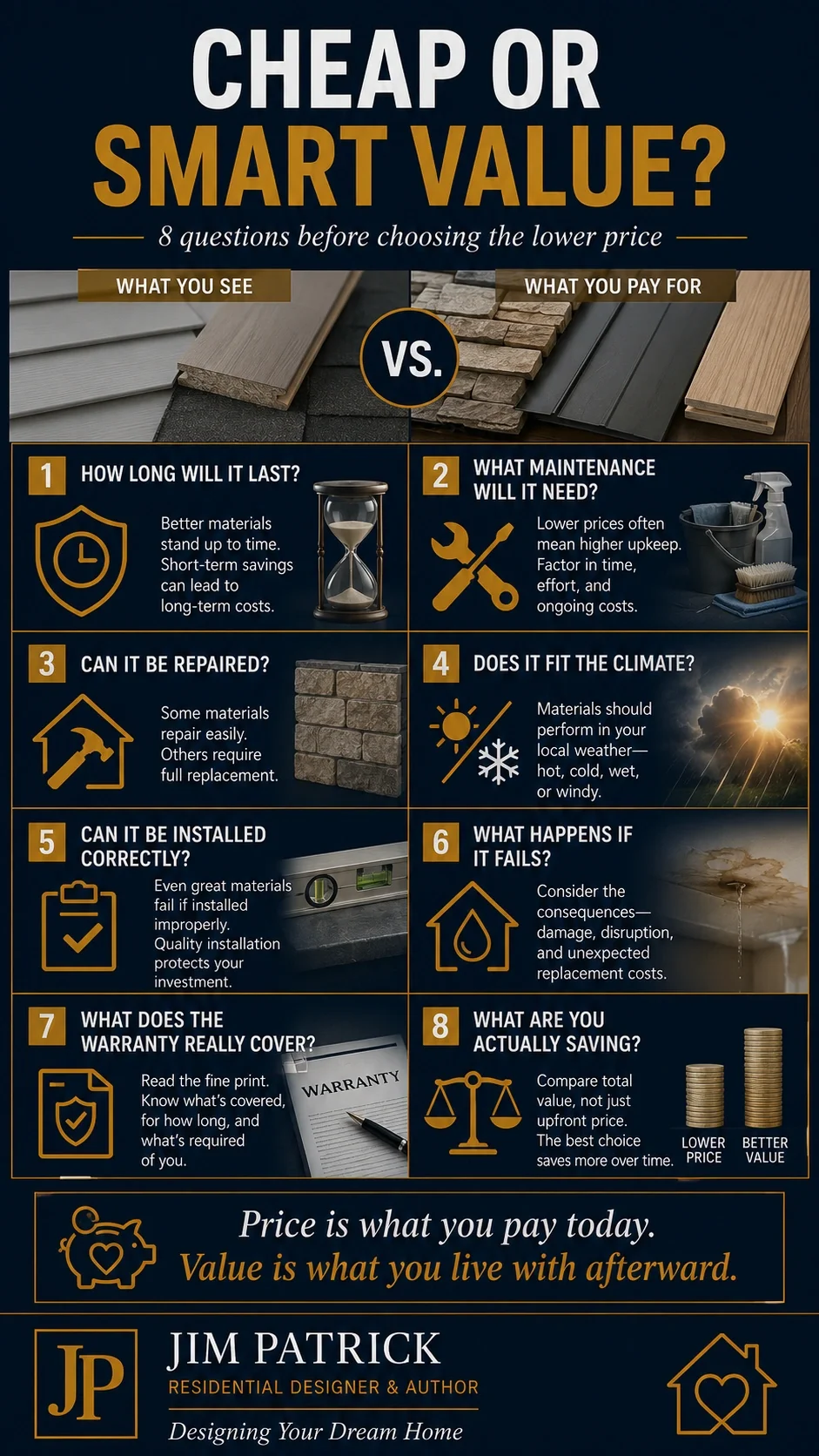
For any meaningful material choice, I would ask:
1. Does It Fit the Application?
Right material.
Right location.
Right assembly.
2. Does It Fit the Climate?
Heat.Cold.Moisture.Sun.Wind.Snow.Pests.3. Will It Be Installed Correctly?
Theoretical performance means little without real installation quality.
4. How Long Should It Last?
And what does "last" actually mean?
5. What Maintenance Does It Require?
Time and money.
6. How Difficult Is It to Repair?
Small repair or major replacement?
7. What Does the Upgrade Actually Improve?
Performance?Durability?Comfort?Appearance?Maintenance?8. Is This the Best Place for the Money?
This is the final question.
Even a good upgrade may not be your highest priority.
A Practical Material Value Scorecard
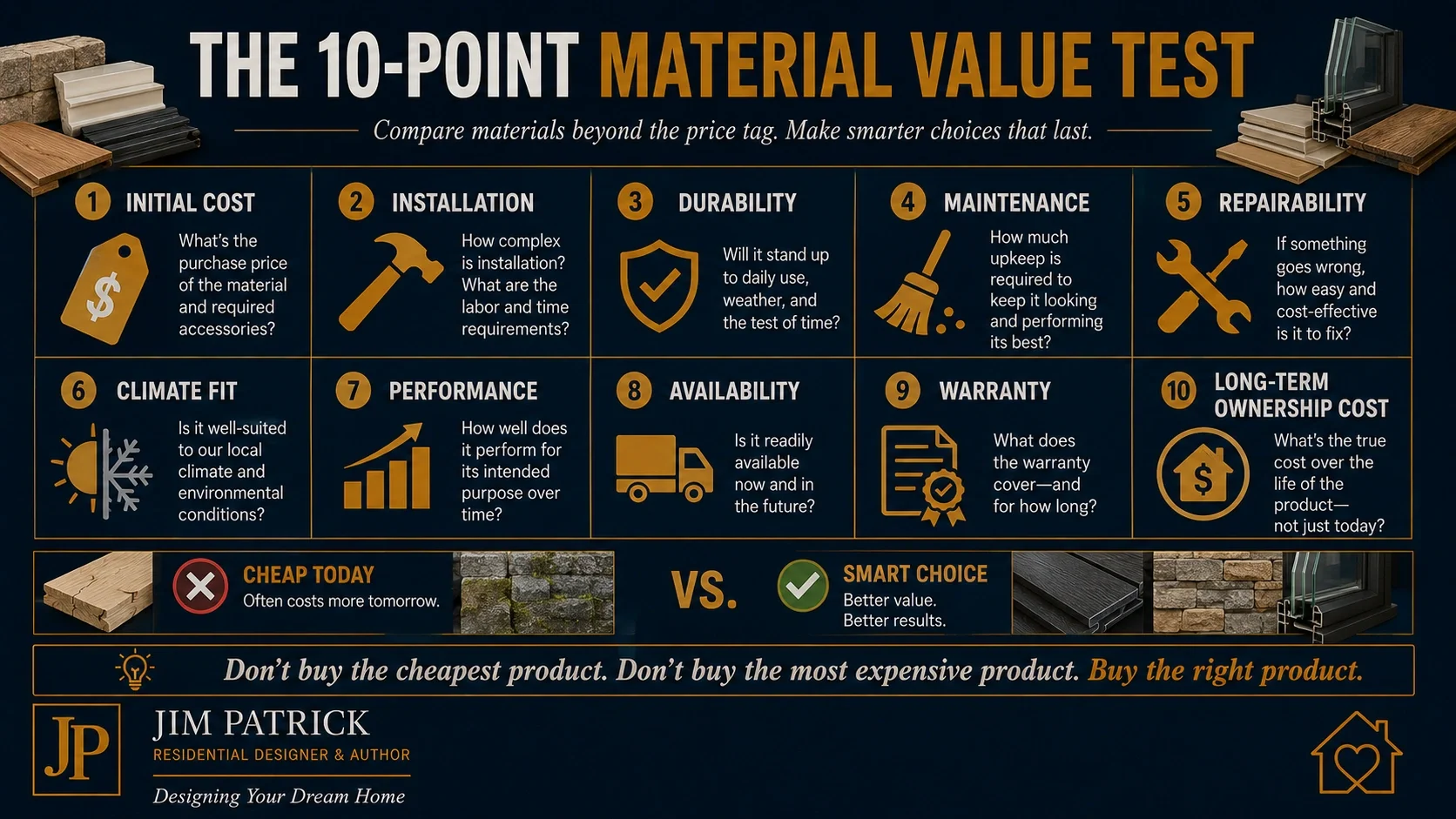
Rate each important material from 1 to 5.CategoryScoreInitial cost/5Durability/5Maintenance/5Climate suitability/5Installation confidence/5Repairability/5Availability/5Energy/comfort benefit/5Warranty usefulness/5Long-term ownership fit/5Do not become obsessed with the mathematical total.Use the scorecard to expose tradeoffs.You may realize:"We're paying substantially more and only improving appearance."Maybe you still want it.Fine.Or:"This costs a little more, but it scores better almost everywhere that matters to us."Now the decision becomes easier.How I Would Think Through This With a Client
If you were sitting across the desk from me comparing two materials, I would not automatically recommend the more expensive one.I would start asking questions.Where are we using it?What job is it doing?What will it be exposed to?What supports it?What is behind it?How is water handled?Who installs it?Have they installed it before?What maintenance does it require?How long are you planning to own the home?Can we repair it?Can we replace part of it?Can we buy it locally?What does the warranty actually cover?What exactly are we getting for the extra cost?Then I would ask:If we don't spend the extra money here, where could those dollars create more value somewhere else?
That is an important question.Maybe the upgraded siding is worth it.Maybe I would rather put the money in the windows.Maybe the windows are already appropriate and the money belongs in insulation.Maybe all three are fine and the garage is too small.Maybe the smartest choice is simply to keep the project under budget.You have to look at the entire home.What This Decision Affects
Building material value affects far more than material cost.
Construction Budget
The obvious one.
Long-Term Budget
Maintenance, repair, energy, and replacement continue after construction.
Comfort
Windows, insulation, HVAC-related construction, air sealing, and moisture control can affect everyday living.
Durability
Some decisions influence how well the home survives weather and use.
Maintenance
Different products create very different ownership responsibilities.
Construction Schedule
Special-order or unfamiliar products may affect lead times and installation.
Labor
Some products require considerably more labor.
Structure
Heavy, large, or unusual materials may affect framing or foundation design.
Water Management
Material transitions and installation details matter.
Repairability
Products eventually get damaged.
Resale
Broadly accepted, durable, well-maintained materials may create different buyer perceptions from highly specialized products.
Future Flexibility
Materials that can be serviced or replaced without major reconstruction preserve options.Everything is connected.Common Building Material Value Mistakes
Mistake 1: Choosing the Lowest Price Automatically
Price does not tell the full ownership story.
Mistake 2: Assuming Expensive Means Better
Premium pricing does not guarantee additional value.
Mistake 3: Comparing Unequal Proposals
Make sure specifications and installation scope match.
Mistake 4: Ignoring Maintenance
Maintenance has both financial and personal cost.
Mistake 5: Ignoring the Installer
A good material needs good workmanship.
Mistake 6: Buying by Warranty Length
Read what is actually covered.
Mistake 7: Choosing for Another Climate
Regional conditions matter.
Mistake 8: Overspending on Visible Finishes
Do not sacrifice hidden performance automatically.
Mistake 9: Buying Every Upgrade
Your budget has priorities.
Mistake 10: Rejecting Every Upgrade
Some improvements genuinely earn their cost.
Mistake 11: Ignoring Repairability
Products will eventually be damaged.
Mistake 12: Ignoring Availability
Today's specialty product may be difficult to match later.
Mistake 13: Waiting Too Long
Major selections can affect plans, pricing, rough openings, and construction schedules.
Mistake 14: Looking at the Product Instead of the Assembly
Materials need to work together.
Questions I Would Ask Before Choosing a Major Building Material
What job does this material perform?Is it appropriate for this application?Is it appropriate for our climate?How long has the product been available?Is there a proven performance history?Who manufactures it?Is the manufacturer established?Who supplies it locally?How readily available is it?Who will install it?Has that installer used it before?Does installation require special training?What materials surround it?Are they compatible?How does water move around it?How does the assembly dry?What maintenance is required?How frequently?Can we do that maintenance ourselves?Will we want to do it twenty years from now?What happens if the product is damaged?Can one section be repaired?Can replacement materials be matched?What is the expected service life?What does the warranty actually cover?Does warranty coverage depend on installation conditions?Is labor covered?Is the warranty transferable?Is coverage prorated?What does the higher-priced option improve?Will we notice that improvement?Does it improve comfort?Durability?Maintenance?Energy performance?Appearance only?What would the lower-priced option give up?Is that compromise acceptable?Is this upgrade more important than another need elsewhere?Which option represents the best overall value for our home?
That last word matters.Our.
The best material for somebody else's home may not be the best material for yours.
Building Material Value Checklist
Before making a major selection:Application identifiedClimate suitability reviewedStructural impact reviewedWater-management details consideredSurrounding materials checked for compatibilityInstallation method understoodInstaller experience confirmedInitial material price comparedInstallation cost comparedMaintenance requirements comparedExpected service life comparedRepairability comparedReplacement cost consideredAvailability consideredEnergy impact considered where applicableComfort impact consideredWarranty readWarranty exclusions understoodOwnership horizon consideredResale relevance consideredUpgrade benefit clearly identifiedAlternative use of the money consideredFull assembly cost comparedDecision made early enough to protect plans and schedule
Do that and you are no longer shopping only by price.You are shopping for value.Key Takeaways
The cheapest building material is not automatically the least expensive material to own.The most expensive material is not automatically the best value.Building material value includes purchase price, installation, durability, maintenance, repair, replacement, energy performance, regional suitability, and long-term ownership.Smart value can mean spending less.Smart value can also mean spending more.Spend more when the additional money creates a meaningful benefit.Do not upgrade simply because something is labeled premium.Installation quality can matter as much as product quality.Climate matters.Water management matters.Repairability matters.Availability matters.Warranty length alone does not prove value.Hidden materials can deserve higher priority than visible finishes.Products should be evaluated as parts of a complete building system.And every significant upgrade deserves one question:What problem does this additional money solve?
Designer's Advice
If you were sitting across the desk from me with two samples and two prices, I would not point at the expensive one and tell you:"That's the good one."And I would not point at the inexpensive one and tell you:"That's the cheap one."There is not enough information.I would want to know what each one does.How it performs.Where we are using it.Who installs it.What maintenance it requires.What happens when it gets damaged.How well it fits our climate.How long you plan to own the house.And what you are giving up somewhere else if we spend more here.I've spent most of my life around building products.I've watched expensive products disappoint people.I've watched modest products perform beautifully for decades.I've watched products get blamed for installation failures.I've watched homeowners save money in exactly the right place.And I've watched others save a few dollars during construction only to spend considerably more correcting the decision later.That is why I do not like the word cheap unless we know what we mean.
Low price is not the same as poor value.And high price is not the same as quality.The real goal is much simpler:Buy what the home needs.
Pay for improvements that matter.
Avoid paying for improvements that don't.
And whenever possible, think beyond move-in day.Because construction cost lasts until closing.Material decisions can follow you for decades.Related Articles
Continue planning with:Choosing Building Materials for a House: What Homeowners Should UnderstandMaterials That Affect the Cost of a Home Before You Ever See ThemWhy a Pretty House Plan Is Not the Same as a Buildable ProjectFuture-Ready Home Design: What to Think About Before You BuildWhy HVAC Planning Should Start Before the Plan Is FinishedThe Hidden Costs of Building a Larger HomeThe First 30 Days of Planning a Custom HomeThe Right Way to Start Planning Your Dream Home
Want to Make Better Material Decisions Before Construction?
Material decisions become easier when they are connected to a clear understanding of your family, budget, property, floor plan, climate, long-term plans, and priorities.My free Dream Home Planning Checklist will help you organize those decisions before construction turns inexpensive questions into expensive changes.Download the Free 24-Page Dream Home Planning Checklist
The goal is not to build the most expensive home.The goal is not to build the cheapest home.The goal is to spend wisely on the right home.
Frequently Asked Questions About Building Material Value
What Does Building Material Value Mean?
Building material value is the relationship between the total cost of a product and the performance it delivers for a specific home.That can include purchase price, installation, service life, maintenance, repairability, energy performance, climate suitability, availability, and replacement cost.Are Cheap Building Materials Always Bad?
No.A lower-priced material can be an excellent value when it performs its intended job, is appropriate for the application and climate, can be installed correctly, and provides acceptable durability and maintenance.Low price and poor quality are not the same thing.Are Expensive Building Materials Always Better?
No.A higher-priced product may provide better performance or durability, but the improvement needs to matter in your specific application.Sometimes a moderately priced proven product provides better overall value.What Is Life-Cycle Cost?
Life-cycle cost looks beyond initial purchase price and considers costs that occur during ownership, including installation, maintenance, repair, operation, and replacement.The concept helps homeowners compare what a product costs over time rather than only on construction day.Which Building Materials Are Worth Spending More On?
Higher-cost materials may be worth considering where additional investment meaningfully improves structural performance, water management, durability, comfort, energy efficiency, maintenance, service life, or repairability.The right answer depends on the home, climate, budget, installer, and ownership goals.Where Should I Avoid Cutting Material Costs?
Be especially thoughtful about materials that are difficult to replace, responsible for structural performance, part of the water-management system, or hidden inside completed assemblies.That does not mean choosing the most expensive option.It means understanding the consequences of the choice.How Important Is Installation Quality?
Extremely important.A high-quality product can perform poorly when preparation, flashing, fastening, detailing, or installation is incorrect.Product selection and installation strategy should be evaluated together.Does Climate Affect Building Material Value?
Yes.Heat, cold, humidity, rain, snow, wind, sun exposure, pests, and other regional conditions affect how materials perform.A product that provides excellent value in one climate may not be the best choice elsewhere.How Should I Compare Two Building Material Quotes?
Confirm that the proposals include equivalent products, specifications, quantities, preparation, accessories, installation, flashing or detailing, labor, cleanup, warranty responsibilities, and related work.A lower total is not necessarily a lower price for the same result.Are Long Warranties a Sign of a Better Product?
Not necessarily.Warranty duration is only one consideration.Read the actual coverage, exclusions, installation requirements, transfer provisions, labor coverage, claim process, and whether coverage changes over time.Is Low Maintenance Worth Paying More For?
It can be.Reduced maintenance may save both money and personal time over the life of the home.Its value depends on the additional initial cost, expected maintenance difference, ownership period, and your personal priorities.How Long Should Building Materials Last?
There is no universal answer.Expected service life varies by product, climate, exposure, installation, use, and maintenance.Compare realistic expectations for the specific products being considered rather than relying on one general number.What Is the Best Question to Ask About a Material Upgrade?
Ask:
What problem does this upgrade solve?
Then decide whether solving that problem is worth the additional cost for your particular home.