
How Change Orders Start Before Construction Begins
Estimated Reading Time: 18 Minutes
Category: Building Process Project Management
Published: October 9, 2026
Quick Summary
Most homeowners think a change order begins when someone says:
“Can we change this?”
Sometimes it does.
But many construction change orders actually begin much earlier.
They begin when:
A floor plan was approved before it was fully studied.
A kitchen layout was never completely resolved.
A homeowner assumed something was included when it was actually an allowance.
A window location was approved before furniture was considered.
Electrical decisions were postponed.
The exterior was not fully developed.
Material selections remained open too long.
A homeowner kept collecting new ideas after construction started.
Or two people simply had different understandings of what the builder's price included.
The actual change order may not appear until framing, electrical, cabinetry, or finishes.
But the conditions that created it may have existed for months.
That is why one of the best ways to avoid change orders when building a house is not to become better at saying no during construction.
It is to make more thoughtful decisions before construction begins.
No project will eliminate every change.
Unexpected site conditions happen.
Products become unavailable.
Better solutions occasionally appear.
Mistakes sometimes need to be corrected.
But there is a major difference between a necessary construction change and an expensive change that exists because an important decision was never really finished.
After nearly fifty years around residential design, building materials, and construction, one principle has become very clear to me:
The cheapest change order is the one that happens on paper before anyone picks up a hammer.
Direct Answer: Why Do Change Orders Happen in Home Construction?
Change orders happen when the agreed scope, price, materials, design, or construction schedule needs to change after the original agreement has been established.
Common causes include:
Homeowner-requested design changes
Incomplete decisions before construction
Allowances that do not match homeowner expectations
Material substitutions
Product availability
Unforeseen site conditions
Structural discoveries
Code or inspection requirements
Design clarifications
Errors or omissions
Builder or trade recommendations
New homeowner ideas during construction
A change order itself is not automatically a problem.
Professional construction contracts need a way to document legitimate changes.
The problem is allowing preventable uncertainty to follow the project onto the jobsite.
That uncertainty is where many custom home construction mistakes become expensive.
What Is a Construction Change Order?
In simple terms, a change order formally modifies an existing construction agreement.
It may change:
The work.
The price.
The schedule.
Or some combination of those things.
The American Institute of Architects describes its G701 Change Order as the document used when owner, contractor, and architect have agreed to a change and its effects on the contract sum and contract time.AIA Contract Documents — G701 Change Order
ConsensusDocs uses a similar approach. Its standard Change Order form documents agreed modifications involving project scope, contract price, and schedule.
ConsensusDocs — 202 Change Order
The exact procedure on your project depends on your contract and applicable state and local requirements.
But the underlying lesson is important:
A change order should clarify what is changing and what that change does to the project.
Change Orders Are Not Automatically Bad
I want to establish this early.
I am not against change orders.
Some are absolutely worthwhile.
Maybe excavation reveals something nobody could reasonably know beforehand.
Maybe an engineering issue needs to be resolved.
Maybe a product becomes unavailable.
Maybe the homeowner discovers a genuine improvement.
Maybe somebody catches an error before it becomes a bigger problem.
Those changes may be necessary.
And occasionally spending more money produces a substantially better home.
The question I ask is:
What problem are we solving?
Then:
What does it cost?
What else does it affect?
Does it affect the schedule?
Is the improvement worth those consequences?
A worthwhile change order is not necessarily an inexpensive change order.
It is one whose value justifies its cost and disruption.
Good change orders solve problems.
Poorly considered change orders create new ones.
Why Change Orders Often Begin Before Construction
This is the part homeowners do not always see.
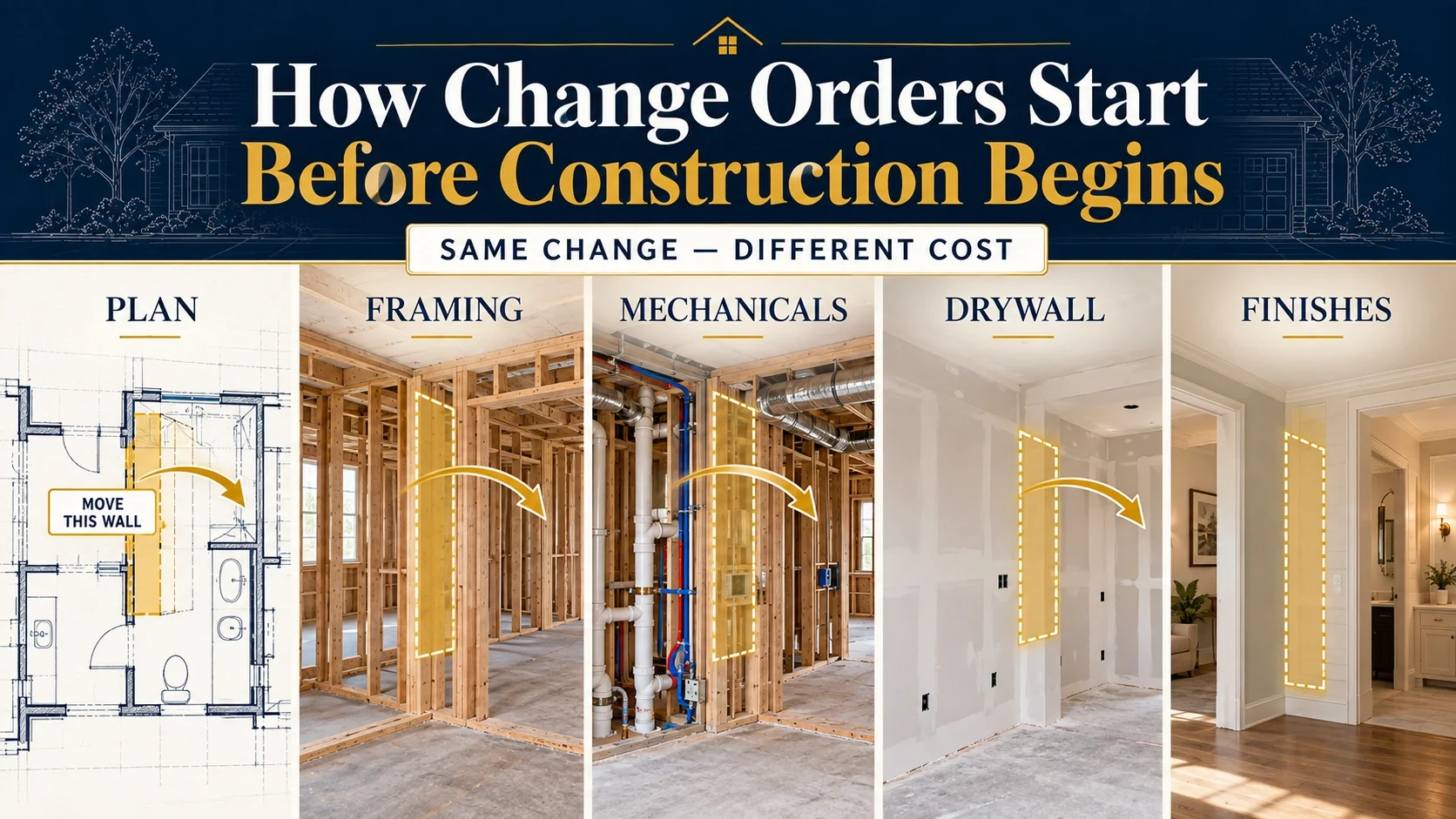
Imagine the framing is complete and you decide a wall should move.
The change order appears today.
But why did the change happen?
Maybe the furniture was never placed on the floor plan.
Maybe the room was never mentally walked through.
Maybe nobody asked how traffic would move around the furniture.
Maybe the homeowners were still uncertain when the plan was approved.
The carpenter did not create the problem.
Construction simply exposed a decision that was never completely resolved.
This is why I encourage homeowners to use The Floor Plan Walk-Through Test Every Homeowner Should Use and How to Review a Floor Plan Before Building before construction begins.A drawing is much cheaper to change than a framed wall.
Planning Is Where Changes Should Be Cheap
I expect plans to change during design.
They should.
Ideas need to be:
Questioned.
Tested.
Moved.
Compared.
Refined.
Sometimes discarded.
That is not wasted time.
That is exactly what design is supposed to accomplish.
Move the wall on paper.
Make the island larger on paper.
Try a different stair location on paper.
Change the garage on paper.
Move the windows on paper.
Study another exterior on paper.
That may require additional design time.
But design changes are usually far less disruptive than reversing completed construction.
I would rather have a homeowner challenge a plan ten times before construction than discover ten major problems after framing.
A Buildable Plan Reduces Construction Uncertainty
There is another important distinction.
A floor plan can look finished to the homeowner while important construction questions remain unresolved.
That is why I wrote Why a Pretty House Plan Is Not the Same as a Buildable Project.
Construction needs more than attractive rooms.
It needs enough information for builders, suppliers, engineers, truss companies, cabinet suppliers, mechanical contractors, and other trades to understand what is actually being built.The more ambiguity that reaches the field, the greater the opportunity for:
Questions.
Assumptions.
Clarifications.
Pricing differences.
Delays.
And changes.
Good planning does not guarantee that nothing will change.
It reduces the number of things that should have been decided earlier.
Designer's Experience: The Change That Delayed Everything
Several years ago, a homeowner decided to make a substantial revision after framing was largely complete.
The requested change was understandable.
The homeowner genuinely believed it would improve the final home.
The problem was timing.
The framing crew had already completed its work.
Mechanical contractors were preparing to begin.
Materials had been ordered.
The change required part of the project to move backward before everyone could move forward again.
It was not a disaster.
The homeowner ultimately received the improvement.
But the ripple effects were much larger than expected.
Schedules moved.
Subcontractors had to be rescheduled.
Inspections were delayed.
Completion dates changed.
That experience reinforced something I have seen repeatedly:
A change order rarely affects only the thing being changed.
The Domino Effect Homeowners Do Not See
Suppose you decide to move one wall.
It sounds straightforward.
Move wall.
Pay carpenter.
Continue building.
But what happens inside that wall?
Maybe:
Electrical wiring.
Switches.
Outlets.
HVAC ducts.
Plumbing.
Blocking.
Then what happens around it?
Cabinet dimensions.
Countertop dimensions.
Flooring transitions.
Trim.
Lighting.
Window spacing.
Furniture.
Drywall.
Paint.
The homeowner sees:
One wall.
The construction project may see:
Six different trades and fifteen related decisions.
That is one reason house plan changes during construction often cost more than homeowners expect.
The visible change is only the beginning.
Structural Change Orders Can Become Expensive Quickly
Not all changes are equal.
Changing paint color before painting begins is one kind of change.
Moving a load-bearing wall after framing is another.
Structural changes can include:
Moving walls
Enlarging rooms
Changing ceiling heights
Expanding garages
Relocating stairs
Adding square footage
Changing window openings
Modifying rooflines
Changing beams
Altering porch or deck structures
A structural change may require additional involvement from:
Designer.
Engineer.
Truss manufacturer.
Framer.
Electrician.
Plumber.
HVAC contractor.
Roofer.
Exterior contractor.
Inspector.
This is why The Design Decisions That Affect Construction Before Groundbreaking is so closely related to this topic.
The earlier structural decisions become stable, the easier the rest of the project becomes to coordinate.
Kitchens Create Change Orders
If there is one part of a home that consistently generates new ideas, it is the kitchen.
That makes sense.
The kitchen is:
Visible.
Expensive.
Heavily used.
Emotionally important.
And full of interdependent decisions.
During construction homeowners may suddenly want:
A larger island.
Different cabinet layout.
Another appliance.
Larger refrigerator.
Different range.
More pantry storage.
Different lighting.
Additional outlets.
Different sink.
Additional cabinetry.
None of those ideas is necessarily bad.
But kitchen decisions connect to:
Cabinetry.
Plumbing.
Electrical.
HVAC.
Flooring.
Countertops.
Lighting.
Windows.
Framing.
Appliance clearances.
That means one late kitchen idea can become several changes.
I've learned that homeowners rarely regret spending extra time resolving the kitchen before construction begins.
Appliances Should Be Considered Before Cabinets Become Permanent
This is a perfect example.
Suppose the plan assumed a 36-inch refrigerator.
Later you choose a significantly different appliance package.
That decision may affect:
Cabinet widths.
Panels.
Electrical requirements.
Water line.
Clearances.
Adjacent countertop.
Ventilation.
Door swing.
Traffic.
Now the appliance change is no longer simply an appliance decision.
It has become a cabinet and construction decision.
The earlier major products are understood, the easier it is to coordinate everything around them.
Bathrooms Are a Close Second
Bathrooms generate similar temptation.
The original plan seems fine.
Then the homeowner visits a showroom.
Or sees a friend's house.
Or finds a photograph online.
Suddenly:
Shower gets larger.
Vanity changes.
Freestanding tub appears.
Heated floor gets added.
Different plumbing fixtures are selected.
Storage changes.
Lighting changes.
Again, these may be wonderful improvements.
But construction budgets are rarely destroyed by one outrageous decision.
They are more often stretched by many reasonable-sounding small decisions.
That is why change-order discipline matters.
Electrical Changes Have a Way of Multiplying
Electrical changes look inexpensive individually.
One extra outlet.
Another recessed light.
Move a switch.
Add under-cabinet lighting.
Add exterior lighting.
Move television location.
Add floor outlet.
Add charging station.
Individually, none sounds dramatic.
But dozens of them add up.
And timing matters.
An electrical change while the electrician is roughing in the room is different from the same change after:
Insulation.
Drywall.
Cabinetry.
Paint.
The further construction progresses, the more finished work may need to be disturbed.
Windows and Doors Can Trigger Several Other Changes
Move a window and you may affect:
Framing.
Header.
Exterior siding or masonry.
Interior trim.
Electrical.
Cabinetry.
Furniture.
Exterior proportions.
Energy planning.
A door change may affect:
Traffic flow.
Switch locations.
Wall space.
Furniture.
Exterior landing.
Porch.
This is why Windows and Doors: Why Openings Affect More Than Appearance belongs in the preconstruction conversation.
An opening is never simply a hole in a wall.
Exterior Changes Can Become Especially Disruptive
Late exterior changes can involve:
Roofing.
Siding.
Stone.
Windows.
Doors.
Porches.
Rooflines.
Trim.
Gutters.
Framing.
Materials may already be ordered.
Trusses may already be manufactured.
Windows may be in production.
Trades may already be scheduled.
That means a seemingly cosmetic exterior change can affect both money and schedule.
Exterior decisions deserve extra attention before materials are released for production.
Selections Made Too Late Can Become Change Orders
Homeowners sometimes think:
“We'll decide that later.”
Sometimes that is perfectly reasonable.
You do not need every paint color selected before excavation.
But some decisions have deadlines because other decisions depend upon them.
The builder may need:
Cabinet selections.
Plumbing specifications.
Appliance information.
Electrical locations.
Exterior materials.
Window package.
Door package.
Flooring.
Lighting.
The homeowner may think:
“Why do they need this already? We aren't anywhere close to installing it.”
Because construction is not only about installation.
Products need to be:
Specified.
Priced.
Ordered.
Scheduled.
Coordinated.
Sometimes fabricated.
Decision deadlines are often protecting the construction sequence.
Construction Is a Moving Train
This is the analogy I like.
Before construction starts, the train is sitting at the station.
You can still:
Change cars.
Move baggage.
Alter the route.
Once the project begins, the train starts moving.
Framing follows foundation.
Mechanical rough-ins follow framing.
Insulation follows mechanical work.
Drywall follows inspections.
Cabinetry follows.
Trim follows.
Finishes follow.
Now ask the project to reverse direction.
Possible?
Sometimes.
Easy?
Usually not.
The farther the train has traveled, the more difficult the change becomes.
The Schedule Has Value Too
Homeowners naturally focus on the dollar amount printed on the change order.
But time has value.
A major change may cause:
Material reorder.
Engineering revision.
Plan revision.
Inspection delay.
Subcontractor rescheduling.
Trade interruption.
Lost production time.
Extended loan carrying costs in some projects.
Later move-in.
The homeowner may never receive an invoice labeled:
“Lost momentum.”
But lost momentum is real.
This is why good construction management involves more than asking:
“How much does the new feature cost?”
Ask:
“What does this do to the rest of the project?”
Why Written Change Orders Matter
Verbal construction changes create unnecessary risk.
A homeowner says:
“Go ahead and do it.”
The contractor hears one thing.
The homeowner expects another.
Three weeks later nobody remembers the conversation exactly the same way.
Industry-standard documents treat changes formally for a reason. AIA's change-order guidance describes the change order as the primary contractual method for modifying construction scope, price, and time.AIA Contract Documents — Fundamentals of Change Orders in Construction
The Federal Trade Commission also advises homeowners to use detailed written agreements that clearly describe work, materials, timing, and price rather than relying on verbal promises.
Federal Trade Commission — How to Avoid a Home Improvement Scam
Specific contract law varies by state and project.
But the practical lesson applies everywhere:
If something important changes, document it.
State Rules Can Be More Specific
Homeowners should also understand that change-order requirements can be governed by state law.
For example, California's Contractors State License Board tells consumers that changes to covered home-improvement contracts should be documented through written change orders, including applicable price changes, and signed as required before the changed work proceeds.California Contractors State License Board — Contracts and Change Orders
That is a California example, not a statement of law for every state.
Your own builder contract and local requirements control your project.
But it illustrates why a casual:
“Let's just do it”
can be a poor construction-management habit.
Allowances Can Create Change Orders Before Construction Even Starts
Allowances deserve special attention.
An allowance is essentially a placeholder amount in the budget for something not completely selected yet.
Examples might include:
Lighting.
Flooring.
Plumbing fixtures.
Appliances.
Cabinet hardware.
Tile.
The allowance itself is not a problem.
The problem comes when the homeowner's expectations and the allowance are far apart.
Suppose:
Lighting allowance = $8,000.
Homeowner's eventual selections = $14,000.
The difference has to go somewhere.
That may become additional cost.
Repeat the pattern with:
Plumbing.
Flooring.
Tile.
Appliances.
Cabinet hardware.
Suddenly the construction budget feels as though it has changed dramatically.
In reality, much of the difference may have been hiding in unresolved selections from the beginning.
Custom Home Allowances Should Be Tested Early
Do not simply ask:
“What is the flooring allowance?”
Ask:
What kind of flooring was assumed?
At what approximate price level?
Does installation count against it?
What about underlayment?
Trim?
Waste?
Transitions?
Likewise:
What faucets fit the plumbing allowance?
What light fixtures fit the lighting allowance?
What appliances fit the appliance allowance?
You do not necessarily need every final product selected before signing a contract.
But you should know whether your expectations and the budget are living in the same neighborhood.
That connects directly to Home Building Budget Mistakes That Start Before Construction Begins.
Allowances Are Not Free Money
This sounds obvious.
But psychologically, allowances can feel abstract.
A homeowner hears:
“You have a $10,000 allowance.”
That can sound like:
“We have $10,000 to spend.”
What it really means is:
$10,000 is already part of the project budget for this category.
Spend $14,000 and the project does not magically absorb the extra $4,000.
This is one reason how change orders affect home cost is more complicated than simply looking at structural changes.
Selections matter too.
Unclear Specifications Create Their Own Risk
Imagine one builder prices:
Standard fiberglass shower.
Another prices:
Fully tiled custom shower.
Both quotes may contain the word:
SHOWER
But they are not pricing the same project.
The same thing can happen with:
Windows.
Doors.
Flooring.
Cabinetry.
Roofing.
HVAC.
Insulation.
Plumbing fixtures.
Appliances.
The less specific the project information, the more assumptions enter the estimate.
Then homeowners may discover during construction that something they expected was never actually included.
That can feel like a change.
Sometimes it is really a scope misunderstanding.
This is why I encourage homeowners to understand What Happens Between a House Plan and a Real Construction Project.
“I Thought That Was Included” Is an Expensive Sentence
Few sentences create more frustration during construction.
“I thought that was included.”
The builder says:
“No, that was an upgrade.”
The homeowner says:
“We discussed it.”
The builder says:
“It was never in the contract.”
Now the construction issue becomes a communication issue.
Specifications matter.
Written selections matter.
Contracts matter.
Clear drawings matter.
Good builder communication matters.
The less everyone has to remember from conversations, the better.
Social Media Has Increased Change-Order Temptation
When I started in residential design, homeowners gathered ideas from:
Magazines.
Model homes.
Friends.
Occasional product catalogs.
Today the idea machine never stops.
Pinterest.
Instagram.
Facebook.
YouTube.
Design sites.
Builder tours.
Online house plans.
A homeowner may see fifty new kitchens after their own cabinets have been ordered.
That creates temptation.
Suddenly:
Maybe our island is too small.
Maybe we need a beverage center.
Maybe we should change the pantry.
Maybe we need another fireplace.
Maybe black windows would be better.
Inspiration is valuable during design.
During construction, endless inspiration can become expensive.
Eventually you have to stop designing and start building.
Know When to Stop Shopping
This may be one of the most valuable skills in the entire construction process.
There comes a point when the question should no longer be:
“What else could we do?”
It becomes:
“Is what we already decided good enough to move forward?”
Perfection is not available.
Every project involves compromise.
Cost versus benefit.
Space versus budget.
Complexity versus simplicity.
The goal is not creating a house containing every good idea you have ever seen.
The goal is creating the right home.
Designer's Experience: The Homeowner Who Saved Thousands
One homeowner I worked with developed a habit I wish more people would adopt.
Whenever a new construction idea appeared, they wrote it down.
They did not immediately call the builder and say:
“Change this.”
They created a running list.
Every few weeks, we reviewed it.
Some ideas survived.
Many disappeared.
The emotional excitement wore off.
The truly valuable ideas remained.
By the end of the project, that homeowner estimated that this simple habit had saved thousands of dollars.
More importantly, it reduced stress.
That taught me something important:
Not every new idea deserves immediate action.
Sometimes the smartest change-order strategy is waiting long enough to decide whether you really want the change.
Use a 48-Hour Rule for Non-Urgent Changes
This is not a construction requirement.
It is simply a useful homeowner discipline.
For non-urgent discretionary changes, write the idea down.
Then ask:
Do we still want this tomorrow?
What problem does it solve?
Is the existing design actually bad?
Or did we simply see something new?
What does the change cost?
What else does it affect?
Will we care about this five years from now?
Some ideas become even more compelling after reflection.
Those may be worth pursuing.
Others disappear.
Those are the change orders you are glad you never approved.
How to Avoid Change Orders Before Construction
This is one of the strongest long-tail questions in our current search research, and the answer is not:
“Never change anything.”
Instead:
Make more decisions while they are inexpensive to change.
Before groundbreaking:
Study the floor plan.
Walk the plan mentally.
Place furniture.
Review storage.
Study traffic flow.
Review elevations.
Review windows and doors.
Discuss electrical needs.
Discuss HVAC and mechanical spaces.
Review major materials.
Understand allowances.
Identify major appliances.
Discuss future needs.
Review the plan with the builder.
Understand what is included.
Understand what is excluded.
You will not eliminate every construction change.
But you can reduce the preventable ones dramatically.
Use the Floor Plan Walk-Through Before Approval
Pretend the home already exists.
Walk from:
Garage to kitchen.
Bedroom to bathroom.
Bedroom to laundry.
Kitchen to pantry.
Kitchen to patio.
Front entry to powder room.
Now put furniture in the rooms.
Where is the television?
Bed?
Dining table?
Sofa?
Desk?
Then imagine:
Doors opening.
Cabinets opening.
Appliances opening.
People walking.
This is why Traffic Flow Mistakes That Make a Home Frustrating is really a change-order prevention article too.
Problems found before construction are cheap problems.
Ask the Builder to Review the Plan Before the Price Becomes Final
A builder may notice things from a construction perspective that the homeowner and designer should discuss.
Availability.
Typical local construction methods.
Cost-sensitive details.
Trade sequencing.
Product concerns.
Site access.
Structural complexity.
This is not about letting the builder redesign the home.
It is about getting useful construction input early enough to act on it.
I have believed throughout my career that design and construction should communicate with one another.
A beautiful plan still needs to work in the real world.
Review the Site Before Assuming the Plan Is Finished
Some changes are created by the property.
Slope.
Drainage.
Utilities.
Soils.
Driveway.
Setbacks.
Rock.
Trees.
Existing grades.
A house cannot be completely separated from its site.
This is why Lot Planning for a New Home: Let the Site Shape the Plan and Buying Land to Build a House: What to Check Before You Fall in Love With the Lot matter before construction.
The better the site is understood early, the fewer surprises are likely to appear later.
Some Change Orders Cannot Be Predicted
No matter how well you plan, construction is still construction.
Unexpected conditions happen.
Hidden site conditions.
Weather.
Product shortages.
Code interpretations.
Manufacturing problems.
Field conflicts.
Those are different from preventable indecision.
The goal of good planning is not to promise:
“There will be zero changes.”
That would be unrealistic.
The goal is to preserve your budget and attention for the changes you genuinely could not anticipate.
Contingency Is Not Permission to Stop Planning
A project may include some form of contingency.
That is wise.
But contingency should not become:
“We have extra money, so we can figure everything out later.”
Unexpected things deserve contingency.
Unresolved decisions should be resolved whenever practical.
The more preventable changes consume the cushion, the less protection remains for real surprises.

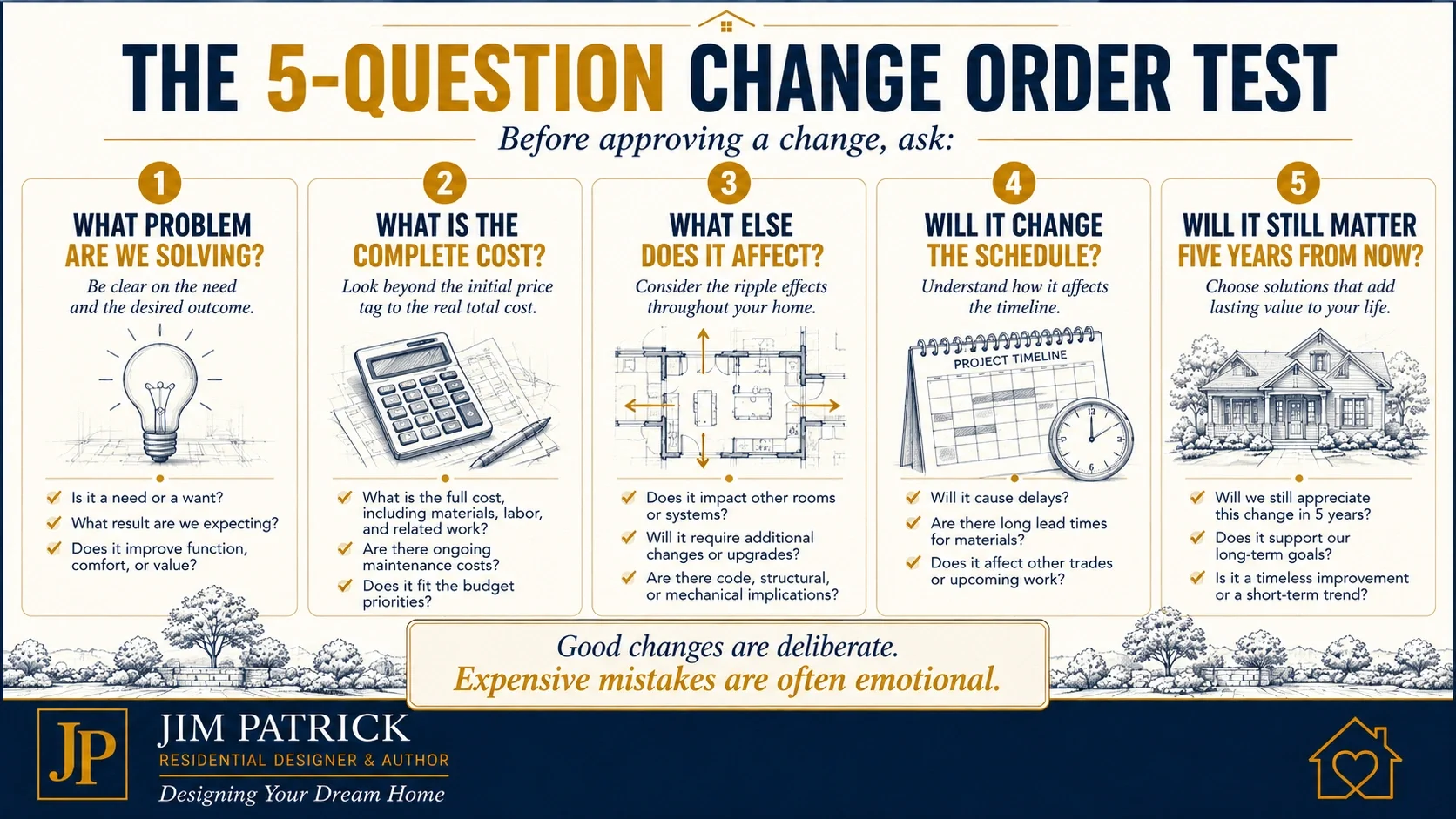
Every Change Should Answer Five Questions
Before approving a significant construction change, I would want answers to:
1. What Problem Are We Solving?
Is the current design actually wrong?
2. What Is the Complete Cost?
Not only material cost.
Labor.
Design.
Engineering.
Demolition.
Rework.
Other trades.
3. What Else Does It Affect?
Look for the domino effect.
4. Does It Change the Schedule?
Products and trades may need to be rescheduled.
5. Is It Worth It?
Will this improvement matter enough over the life of the home?
Those five questions slow the emotional part of the decision down.
That is usually helpful.
Do Not Approve an Important Change Without Understanding Price and Time
Sometimes construction requires quick decisions.
But whenever practical, understand:
What is being changed?
What is being removed?
What is being added?
How much does the contract price change?
Does the completion date change?
Does another part of the project need revision?
AIA and ConsensusDocs both structure standard change-order documents around exactly these issues: changed work, contract price, and contract time.
That is not accidental.
Those are the consequences homeowners need to understand.
How Change Orders Affect Home Cost
The simplest formula is:
New work costs money.
But that is incomplete.
Change orders may involve:
New material.
Removed material.
Restocking fees.
Additional labor.
Demolition.
Design revisions.
Engineering.
Trade remobilization.
Schedule effects.
Overhead.
The exact pricing method depends on the construction contract.
This is why the apparent retail price of the changed item may not resemble the final change-order amount.
You are not always buying just the item.
You may be changing part of the construction process.
This Is Another Reason Cost Per Square Foot Can Mislead You
A home does not cost money only because it contains square footage.
Complexity costs money.
Changes cost money.
Rework costs money.
Different products cost money.
Different assemblies cost money.
That is why Why Cost Per Square Foot Can Mislead Homeowners is important context.
Two homes of identical size can have completely different levels of design certainty, construction complexity, and change-order exposure.
Builder Communication During Construction Matters
Good communication does not mean calling the builder every hour.
It means having a clear system.
Who approves changes?
How are changes priced?
Who sends the documentation?
When must the homeowner respond?
What happens to the schedule?
How are credits handled?
Where are selections recorded?
Construction already involves hundreds of moving parts.
Clear communication keeps uncertainty from becoming chaos.
Document Decisions
You do not need a three-ring binder for every conversation.
But important decisions should be retrievable.
Cabinet selection.
Window selection.
Door style.
Appliance model.
Plumbing fixture.
Lighting.
Flooring.
Change approval.
If six months later everyone has to rely on memory, you have created unnecessary risk.
Documentation is not distrust.
It is clarity.
Do Not Chase Perfection
Building a home is a major investment.
Of course you want it right.
But there is a point where the desire for perfection creates its own problems.
Every detail can always be reconsidered.
Every product has another option.
Every plan can be adjusted.
Every room can be improved another one percent.
Eventually the project must become real.
The most successful homeowners I have worked with were not the ones who never saw another idea.
They were the ones who knew when a new idea was worth disrupting the project.
When a Change Order Is Worth the Money
A change may be worthwhile when it:
Corrects a real problem.
Substantially improves daily living.
Protects long-term value.
Addresses safety or code concerns.
Responds to genuine site conditions.
Prevents a larger future expense.
Creates an opportunity that would be extremely difficult to add later.
The goal should not be:
Never approve a change order.
The goal should be:
Make changes deliberately.
When I Would Be Cautious
I would slow down when the reason is:
“I saw this online yesterday.”
“My neighbor has one.”
“We might as well.”
“It is only another few thousand dollars.”
“We have already spent this much.”
“I don't know why, but now I don't like it.”
Those reactions are human.
But they deserve reflection before they become construction instructions.
What Change Orders Affect
Budget
The obvious one.
Schedule
Often overlooked.
Subcontractors
Multiple trades may need to adjust.
Materials
Ordered items may need to change.
Drawings
Plans may need revision.
Engineering
Structural changes may require additional design.
Inspections
Previously scheduled inspections may move.
Financing
Cost increases may affect cash requirements or loan administration.
Decision Fatigue
Every change creates more decisions.
Stress
Uncertainty accumulates.
Relationships
Poor communication can create unnecessary conflict between homeowner, builder, designer, and trades.
A change order is rarely isolated.
Common Change-Order Mistakes
Mistake 1: Approving the Floor Plan Too Early
Keep asking questions while the changes are still lines.
Mistake 2: Continuing to Design After Construction Starts
Eventually design decisions need to become commitments.
Mistake 3: Not Understanding Allowances
Know what level of product the budget assumes.
Mistake 4: Relying on Verbal Agreements
Important changes belong in writing.
Mistake 5: Looking Only at the Price of the New Item
Consider labor, rework, design, and schedule.
Mistake 6: Ignoring the Domino Effect
One wall may touch several trades.
Mistake 7: Making Emotional Changes Immediately
Give discretionary ideas time.
Mistake 8: Missing Selection Deadlines
Late decisions can affect ordering and scheduling.
Mistake 9: Assuming Every Change Is the Builder's Fault
Some changes originate with homeowners, site conditions, design, availability, inspectors, or trades.
Mistake 10: Assuming Every Change Order Is Bad
Some solve genuine problems.
Mistake 11: Using Contingency as a Shopping Fund
Protect it for true uncertainty.
Mistake 12: Chasing Perfection
The goal is a successful home—not endless revision.
Questions I Would Ask Before Construction Begins
Have we mentally walked through the floor plan?
Have we placed major furniture?
Is the kitchen layout final?
Are major appliances understood?
Is the pantry resolved?
Are bathrooms resolved?
Have we studied storage?
Is the garage large enough?
Are ceiling heights final?
Are stairs final?
Are window sizes and locations final?
Are exterior doors final?
Is the roofline resolved?
Are exterior materials substantially understood?
Have we reviewed electrical needs?
Are television locations known?
Is the HVAC concept coordinated?
Is the mechanical room resolved?
Are plumbing-fixture expectations realistic?
Have we reviewed allowances?
Do allowances match our taste level?
Are major selections made early enough?
Has the builder reviewed the plan?
Have structural questions been identified?
Is the site sufficiently understood?
Do we know what is included in the builder's price?
Do we know what is excluded?
Is there a written process for changes?
Do we understand how changes affect schedule and price?
Are we ready to stop designing and start building?
Preconstruction Change-Order Prevention Checklist
Floor Plan
Daily traffic tested
Furniture placed
Kitchen finalized
Pantry finalized
Bathrooms reviewed
Storage reviewed
Laundry reviewed
Garage reviewed
Stairs reviewed
Exterior
Window sizes reviewed
Door locations reviewed
Rooflines reviewed
Porch reviewed
Exterior materials understood
Garage appearance reviewed
Building Systems
HVAC planning discussed
Mechanical-room space confirmed
Plumbing expectations understood
Electrical locations reviewed
Lighting concept reviewed
Products and Selections
Major appliances identified
Cabinet expectations understood
Flooring expectations understood
Plumbing-fixture level understood
Lighting-fixture level understood
Window and door package understood
Budget
Allowances reviewed
Allowances tested against likely selections
Exclusions identified
Contingency understood
Upgrade priorities established
Construction Process
Builder reviewed plans
Major structural questions addressed
Site conditions reviewed
Selection deadlines understood
Change-order procedure understood
Price/time impacts required before discretionary changes where practical
Final Question
Are we truly ready to stop designing and start building?
Key Takeaways
Change orders are a normal construction tool.
They are not automatically bad.
But many preventable change orders begin before construction.
Incomplete planning becomes expensive when construction exposes it.
The cheapest place to move a wall is on the drawing.
Structural changes can affect multiple trades.
Kitchen and bathroom changes have strong domino effects.
Late selections can disrupt ordering and scheduling.
Allowances should be understood before construction.
“I thought that was included” is a warning that scope was not clear enough.
Important changes should be documented.
A change can affect both price and schedule.
Social media creates constant temptation to keep redesigning.
Not every new idea deserves immediate action.
Contingency should protect the project—not replace planning.
A worthwhile change order creates more value than disruption.
And above all:
The best change-order strategy is making as many good decisions as possible while the house still exists only on paper.
Designer's Advice
One of the great advantages homeowners have during design is that changing your mind is still relatively cheap.
I want you to use that advantage.
Challenge the plan.
Ask questions.
Move things.
Try alternatives.
Tell your designer:
“I'm not sure about this.”
That is exactly the time to say it.
The problem is not changing your mind.
The problem is waiting until framing, plumbing, electrical, cabinets, or finishes force you to confront something you already suspected months earlier.
After nearly fifty years in this business, I have learned that successful homeowners are not necessarily the people who never change anything.
They are the people who understand the difference between:
A meaningful improvement.
And a new idea.
That distinction matters.
Construction is exciting.
It is also emotional.
For months, you will see new products.
New photographs.
New houses.
New ideas.
Someone will always show you something you could add.
But every project eventually needs commitment.
The house cannot remain a design exercise forever.
At some point:
The foundation needs dimensions.
The framer needs drawings.
The electrician needs locations.
The plumber needs specifications.
The cabinet company needs dimensions.
The suppliers need orders.
That is when planning turns into construction.
And from that point forward, every revision has more consequences.
So take the time now.
Review the plan.
Understand the allowances.
Study the kitchen.
Study the bathrooms.
Look at your furniture.
Look at your routines.
Ask your builder questions.
Make the decisions you can reasonably make.
You will not prevent every change order.
You do not need to.
You simply want to prevent the ones that begin with:
“We probably should have thought about that before we started.”
Those are the expensive lessons good planning can often avoid.
Related Articles
Continue planning with:
What Happens Between a House Plan and a Real Construction Project
The Design Decisions That Affect Construction Before Groundbreaking
Why a Pretty House Plan Is Not the Same as a Buildable Project
Home Building Budget Mistakes That Start Before Construction Begins
Related Video
Start with:
10 Questions to Answer Before Building a House
The more questions you answer before construction, the fewer expensive questions the jobsite is likely to ask later.
Still Have Questions?
Use my Home Building FAQ: 50 Questions to Ask Before You Build to explore more questions involving floor plans, construction, budgets, materials, lots, building systems, and the decisions worth making before work begins.Make the Changes While They Are Still Lines on Paper
My free Dream Home Planning Checklist helps you organize the family, lifestyle, floor-plan, budget, storage, garage, site, and future decisions worth discussing before construction makes changes expensive.Planning does not eliminate every change order.
It helps make sure your budget is not consumed by the ones you could have prevented.
Frequently Asked Questions About Construction Change Orders
What Is a Construction Change Order?
A construction change order is a formal modification to an existing construction agreement.
Depending on the contract, it may document a change in scope, contract price, construction time, or all three.
Why Do Change Orders Happen?
Change orders can result from homeowner requests, incomplete selections, design changes, unforeseen site conditions, product availability, code requirements, errors, construction discoveries, or better solutions identified during the project.How Can I Avoid Change Orders When Building a House?
You cannot prevent every change, but you can reduce avoidable change orders by thoroughly reviewing plans, making major selections early, understanding allowances, placing furniture, studying traffic flow, coordinating major systems, and clarifying what the builder's price includes before construction begins.Are Change Orders Always Bad?
No.
Some change orders solve genuine problems or create improvements worth more than their cost.
The important issue is understanding the full price, schedule, and construction consequences before approving the change.
Why Are Change Orders So Expensive?
A change may affect more than the visible item.
Moving one wall, for example, may affect framing, electrical, HVAC, plumbing, drywall, flooring, cabinetry, trim, paint, and schedule.
Do Change Orders Delay Construction?
They can.
A change may require revised plans, additional materials, engineering, new inspections, or rescheduling of subcontractors.
The schedule effect depends on the type and timing of the change.
Why Are Changes More Expensive After Construction Starts?
Before construction, changing a wall may require editing drawings.
After framing, the same change can require demolition, additional labor, material replacement, trade coordination, and schedule changes.
What Are Common Change Orders in Custom Home Building?
Common areas include kitchens, bathrooms, electrical work, lighting, cabinetry, windows and doors, flooring, exterior materials, structural changes, and upgraded fixtures or finishes.Can Allowances Cause Change Orders?
Yes.
If the contract allowance is lower than the homeowner's eventual selections, the difference may increase the project cost.
That is why allowances should be compared with realistic product expectations before construction.
What Is a Construction Allowance?
An allowance is a budgeted placeholder for an item or category that has not yet been completely selected or priced.
Examples may include lighting, flooring, plumbing fixtures, tile, or appliances.
Should Change Orders Be in Writing?
Important construction changes should be documented according to the requirements of the construction contract and applicable law.
Written documentation should clearly identify what is changing and, where applicable, the effect on contract price and schedule.
Should I Approve a Change Before I Know the Cost?
For discretionary changes, it is generally wise to understand the price and schedule consequences before approving the work whenever practical.
The project's contract should define the formal process.
How Do Change Orders Affect Home Cost?
They may add material, labor, demolition, rework, design, engineering, scheduling, and other project costs.
Some change orders can also reduce cost if work is deleted or substituted.
What Is the Best Way to Control Change Orders?
Make decisions deliberately.
Before approving a change, ask:
What problem are we solving?
What does it cost?
What else does it affect?
Does it change the schedule?
Is the improvement worth the disruption?
What Is the Best Change Order?
The best preventable change order is the one you resolve on paper before construction begins.