
Choosing Building Materials for a House: What Homeowners Should Understand

Estimated Reading Time: 20 Minutes
Category: Building Materials Structure
Published: July 2026
Quick Summary
Choosing building materials is one of the most important parts of planning a new home.It is also one of the easiest places for homeowners to become overwhelmed.There are foundation systems, framing materials, engineered wood products, floor systems, roof systems, wall sheathing, siding, windows, doors, roofing, insulation, decking, trim, interior finishes, and dozens of other decisions.Most homeowners begin by asking:“What is the best material?”That sounds like the right question.Usually, it is too simple.The better question is:What is the right material for this home, this budget, this location, this design, and this long-term plan?
A material can be an excellent choice in one situation and the wrong choice in another. Climate, structure, installation skill, maintenance expectations, availability, local requirements, design goals, and compatibility with the rest of the home all matter.Before choosing building materials for a house, understand that you are not selecting a collection of unrelated products.You are creating a system.That is one reason planning your dream home in the right order matters. The major structural, performance, and material decisions should grow out of the home, property, budget, and people who will live there.Direct Answer
Choosing building materials for a house begins with understanding the job each material must perform. The right choice must fit the home’s structure, climate, water-management strategy, installation method, maintenance expectations, surrounding assemblies, budget, and long-term plan. The best product is not automatically the most expensive or popular product; it is the one that can be detailed, installed, and maintained correctly for that particular home.The Better Way to Think About Building Materials
Do not ask only which material is best. Ask what job the material must do and whether it is the right choice for this particular home.
The most expensive product is not automatically the best choice.The least expensive product is not automatically the best value.The right material is the one that fits the whole situation.Why This Matters
Building materials affect far more than appearance.They affect:StrengthDurabilityComfortEnergy useMoisture controlMaintenanceInsuranceConstruction costConstruction scheduleResale valueLong-term performance
A homeowner may choose siding because they like the way it looks.That matters.But I would also ask how that siding will perform on that wall, with that exposure, over that water-management system, in that climate, and with the installers available for the project.A homeowner may choose windows because of their style.I would also ask about the glass package, frame material, operation, size, weight, installation, flashing, climate-zone performance, natural light, views, and effect on heating and cooling.A homeowner may select a framing system based on price.The framing still has to support the roof, floor system, openings, structural loads, local requirements, and the design of the home.Materials are connected.The foundation affects the framing.The framing affects windows and doors.Windows and doors affect headers and structure.The roof design affects trusses, rafters, sheathing, ventilation, flashing, and drainage.Insulation and air sealing affect comfort and mechanical planning.Siding affects water management and maintenance.Interior materials affect sound, durability, indoor air quality, and daily use.When homeowners treat materials as isolated shopping choices, they may miss how each decision affects the rest of the home.This is also why there is a significant difference between a drawing and what happens between a house plan and a real construction project. Products must be selected, detailed, priced, ordered, installed, and coordinated with the people who will actually build the home.The house is a system.The materials have to work together.The Common Homeowner Misunderstanding
The most common misunderstanding is that there must be one best material in every category.Homeowners hear statements like:“This is the best siding.”“This is the best window.”“This is the best insulation.”“This is the best flooring.”“This is the best wall system.”Those statements may sound confident.They are rarely complete.Best for which climate?Best for which budget?Best for which installer?Best for which wall assembly?Best for which exposure?Best for which maintenance expectation?Best for which homeowner?A material may perform beautifully in one application and poorly in another.Another misunderstanding is that a more expensive product automatically creates a better result.It may.It may not.An upgraded product installed poorly may perform worse than a simpler product installed correctly.A premium material that does not fit the design may create additional labor, structural changes, difficult detailing, or maintenance the homeowner did not expect.A third misunderstanding is that materials can be chosen after the plan is finished.Some colors and decorative finishes can wait.Many major material decisions cannot.Window sizes affect rough openings and headers.Heavy exterior materials may affect structural support.Floor systems affect spans, stairs, plumbing, mechanical routes, and finished-floor elevations.Roofing materials may affect framing, underlayment, flashing, and roof slope.Wall assemblies affect thickness, windows, doors, trim details, moisture control, and energy performance.Waiting too long may require changes to the drawings, pricing, framing, schedule, or products already ordered.This is one reason stock house plans often cost more than homeowners expect. The materials and construction systems assumed by the plan may not match the property, region, builder, local requirements, or products the homeowner ultimately wants.The problem is not that homeowners do not care.Most people build a custom home only once or twice in their lives.They do not know what they have never had a reason to learn.The goal is not to turn a homeowner into a contractor, engineer, or building scientist.The goal is to help the homeowner ask better questions.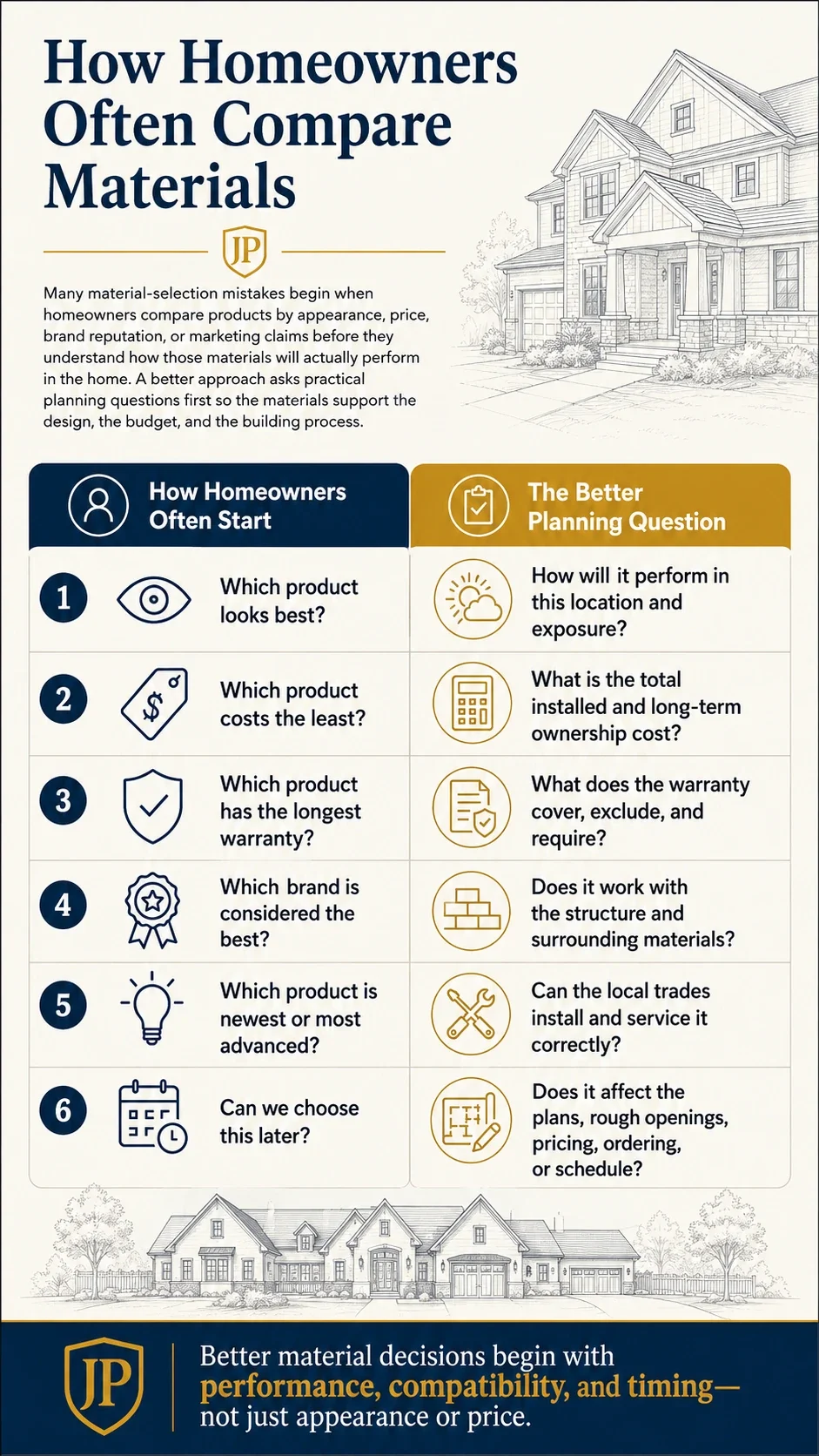
How to Choose Building Materials Before Construction Begins
The best way to choose building materials is to stop thinking of the house as a collection of individual products.

A window affects the wall opening, header, flashing, insulation, trim, energy performance, exterior appearance, natural light, and comfort.

A floor system affects spans, stairs, plumbing, ductwork, ceiling conditions, and finished-floor elevations.

A siding product affects water management, wall preparation, trim, maintenance, installation, and long-term appearance.

Everything is connected.
Think about materials according to the jobs they must perform.Some materials carry loads.Some manage water.Some resist weather.Some control heat and air movement.Some reduce sound.Some protect against wear.Some create beauty.Some reduce maintenance.Some help the home build more efficiently.Most perform more than one job. That is why the most important building material choices should be discussed before construction begins—while the plans, assemblies, pricing, and installation methods can still be coordinated.
The following ten lessons will help you evaluate materials as parts of the complete home rather than as isolated products on a sample board.1. Start With the Structure Before the Finish Materials
Most homeowners want to begin with the materials they can see.That is natural.Siding, roofing, windows, doors, cabinets, flooring, countertops, and fixtures are easier to imagine than footings, headers, subfloor, shear walls, trusses, beams, connectors, and wall assemblies.But the structural decisions come first.The home has to stand correctly before it can look good.Before you choose finish materials, understand the basic structural system supporting them.That may include:Foundation typeFootings and foundation wallsFloor systemWall framingHeader sizingBeams and columnsRoof framingTrusses or raftersSheathingStructural connectorsLoad paths
A large window opening may require a different header.A wide-open great room may require beams, longer spans, floor trusses, roof trusses, or engineered lumber.A heavy exterior cladding may require structural support that a lightweight siding does not.A complicated roof may affect truss design, bearing points, labor, material use, and construction time.I have worked on homes where the floor and roof truss systems influenced plumbing locations, recessed showers, mechanical routes, ceiling details, and structural openings.Those decisions are not made in isolation.They are coordinated.That is one reason homeowners should use a floor plan walk-through before the design is approved. A large opening, special ceiling, oversized window, or unusual room arrangement may affect much more than the appearance of that one space.The house is not a collection of products.It is a connected structure.2. Understand That Local Conditions Matter
There is no universal best material for every home.Climate matters.Soil matters.Wind matters.Snow matters.Humidity matters.Sun exposure matters.Termites and other pests may matter.Local labor and product availability matter.Cold regions, hot-humid regions, coastal areas, high-wind locations, heavy-snow regions, seismic zones, and dry climates place different demands on a home.Local conditions may affect:Foundation depthBasement designConcrete requirementsRoof structureSnow loadsWind resistanceMoisture controlWall assembliesInsulation strategyWindow performanceSiding durabilityRoofing selectionVentilationPest resistance
This is why copying material selections from a home in another part of the country can create problems.The photograph may look right.The assembly may not be right for your climate.A siding material protected by wide roof overhangs may experience very different exposure when placed on a tall wall with little protection.A wall assembly developed for a dry climate may not manage moisture the same way in a hot-humid or cold climate.Windows are a good example. ENERGY STAR explains that certified windows, doors, and skylights must meet performance requirements for factors such as U-factor and solar heat gain, with criteria that vary according to climate. Before choosing them, review ENERGY STAR guidance for residential windows, doors, and skylights and discuss the actual product specifications with your local professionals.National information can help you ask questions.Local experience helps you apply the answers.3. Separate Appearance From Performance
Some materials look similar but perform very differently.Two siding products may have a similar profile while differing in:DurabilityExpansion and contractionMoisture behaviorImpact resistanceInstallationMaintenanceRepairability
Two windows may look nearly identical from the street but perform differently in:Air leakageU-factorSolar heat-gain controlFrame materialHardwareOperationGlass optionsLong-term serviceability
Two flooring products may have similar colors but respond differently to water, scratches, pets, sunlight, furniture, and daily wear.Two roofing products may create the same general appearance while differing in weight, service life, labor, underlayment, fastening, maintenance, and warranty requirements.Appearance matters.You should enjoy the way your home looks.But every material choice should answer two questions:Does it support the design?Will it perform well in this application?That distinction also applies to the exterior. As I explain in why curb appeal starts before you choose a style, siding, stone, trim, and color can strengthen good design, but they rarely correct poor proportions, awkward rooflines, random windows, or a garage that overpowers the home.Do not choose only from the sample board.Ask what happens after the product is installed and lived with.4. Think About Water Before You Think About Color
Water is one of the greatest threats to a home.Before deciding on the exact siding color, homeowners should understand how the home will manage water.Water management may include:Roof drainageGutters and downspoutsFlashingWindow and door installationWeather-resistive barriersWall penetrationsSiding clearancesFoundation drainageGradingPorch and deck connectionsKick-out flashingRoof valleysExterior trim details
A home can have expensive siding and still fail if water is not managed correctly.A high-quality window can still leak if it is installed or flashed incorrectly.A beautiful roof can create problems if valleys, wall intersections, overhangs, drainage, ice, or snow conditions are ignored.Water does not care what the brochure says.It follows gravity.It follows wind.It finds weak details.The Department of Energy’s Building Science Education program explains that properly installed window flashing directs water outward and maintains the drainage plane behind the cladding.That one example shows why materials must be considered together.The window, flashing, weather barrier, sheathing, trim, and siding are separate products.They must act as one water-management system.Good water management is not glamorous.It is one of the most important parts of building a durable home.5. Know That Installation Matters as Much as the Product
A good product installed poorly can become a bad result.This may be one of the most important lessons in material selection.Many products require specific installation methods.That applies to:WindowsDoorsSidingRoofingFlashingInsulationDeckingTileFlooringCabinetsTrimWaterproofingExterior cladding systems
A homeowner may spend more money on an upgraded product and still be disappointed if the installation is rushed, misunderstood, or not coordinated with the surrounding work.Before choosing a product, ask:Who will install it?Have they used it before?Does it require special training?Does it require special tools?Are local trades comfortable with it?Are clear installation instructions available?How does it connect with the work before and after it?Will the required installation be included in the price?Will the installation preserve the warranty?
The best material choice is not always the newest or most advanced product.Sometimes the better choice is a proven product the local trades understand and can install correctly.That does not mean you should avoid innovation.It means innovation needs planning.6. Consider Maintenance Before You Choose
Every material has a maintenance story.Some materials require repainting.Some require sealing.Some require cleaning.Some are more vulnerable to dents, scratches, fading, moisture, insects, or impact.Some are easy to repair.Some may be difficult to match ten years later.A lower-priced material may require more maintenance.A higher-priced material may reduce maintenance.Neither statement is always true.You have to understand the specific product, installation, exposure, and homeowner expectations.Ask yourself:Do we want low maintenance?Are we willing to repaint or reseal?How much sun, wind, rain, snow, or humidity will the material face?Are mature trees close to the house?Will sprinklers regularly wet the siding?Will pets, children, or heavy traffic affect the flooring?Can damaged sections be repaired?Will replacement pieces be available later?Will the color or finish be easy to match?
Maintenance is part of the real cost of a material.A product is not finished costing money on the day it is installed.This is part of the hidden cost of building a larger home. More exterior wall, more roofing, more flooring, more windows, and more finished space create more material to clean, maintain, repair, and eventually replace.The initial price matters.The ownership cost matters too.7. Understand Material Compatibility
Materials have to work together.Sometimes two individual products are good products, but they do not work well together in a particular assembly.Compatibility questions may involve:Exterior cladding and wall drainageInsulation and vapor controlRoofing and ventilationWindow flashing and wall systemsDeck connections and water managementStone veneer and structural supportFlooring and subfloor preparationTile and waterproofingHVAC sizing and insulationAir sealing and ventilation
One choice can affect another.A tighter, better-insulated home may require more deliberate ventilation and indoor-air-quality planning.Large windows may affect heating and cooling loads.Heavy exterior materials may affect framing and foundation support.Certain flooring may require a flatter or more stable subfloor.Some cladding assemblies may require a drainage gap or rainscreen approach.Interior materials can also affect indoor air quality. EPA’s Indoor airPLUS program explains that material selection, protection from weather during construction, lower-emission products, and ventilation can all contribute to better indoor air quality.You do not have to become an engineer or building scientist.You should understand that every major material exists inside a larger assembly.Ask what is behind it.Ask what is attached to it.Ask what depends on it.Ask what happens if it changes.8. Do Not Confuse Warranty With Performance
Warranties can be helpful.They should not be the only reason you choose a material.A long warranty does not prove that the product is right for your home.Warranties may contain:ExclusionsMaintenance requirementsRegistration requirementsInstallation requirementsProrated coverageTransfer restrictionsProduct-only coverageLimited labor coverage
The Federal Trade Commission advises consumers to read what a warranty covers, what it excludes, how claims are handled, and whether labor or other costs are included.Before relying on a warranty, ask:What does it cover?What does it exclude?Is labor included?Is coverage prorated?What installation is required?What maintenance is required?Is registration required?Is the warranty transferable?Who handles the claim?What records must be kept?
Save the warranty.Save the product information.Save the receipt and installation records.A good warranty is useful.A good material, properly installed in the right application, is better.9. Balance Budget With Long-Term Value
The cheapest material is not always the lowest-cost material.The most expensive material is not always the best investment.The right choice depends on value.A material may justify a higher price if it:Improves durabilityReduces maintenanceImproves comfortSaves energySupports resaleReduces future repairsSolves a real performance problem
But not every upgrade is worthwhile.Some upgrades are mostly cosmetic.Some are valuable only in particular markets.Some require more labor than the benefit justifies.Some add complexity without improving the way the home performs.The material upgrades worth paying for are usually the ones that improve durability, water management, comfort, maintenance, energy performance, serviceability, or the way the family uses the home every day.That does not mean every performance upgrade is automatically worthwhile.The question is not simply whether the upgraded material is better.The question is whether the improvement matters enough in this particular application to justify its cost.Before upgrading a material, ask:What problem does this solve?Does it improve performance or only appearance?Will it reduce maintenance?Will it improve comfort?Will we notice the benefit every day?Will it help resale in our market?Does it fit the budget without weakening more important areas?Is there a simpler option that performs nearly as well?
This is where priorities matter.One of the biggest mistakes homeowners make before designing a home is becoming committed to visible features before deciding what the home and budget truly need to accomplish.The best material plan does not spend money everywhere.It spends money where it matters most.10. Choose Materials Early Enough to Protect the Design
Some material decisions need to be made earlier than homeowners expect.These may include:Structural systemsFloor systemsRoof systemsWindowsExterior doorsGarage doorsSiding typesMasonry or stone veneerInsulation strategyMajor flooring transitionsMechanical-system coordination
Waiting too long may create problems.The plan may need to change.Rough openings may not match the products.Framing may need adjustment.Exterior details may not work.Lead times may delay the project.Budget numbers may change.Subcontractor schedules may be affected.Early material planning does not mean you must immediately select every paint color, cabinet finish, faucet, and door handle.It means the products and systems that affect the drawings, structure, performance, budget, and schedule should be discussed before the project moves too far ahead.Good planning creates choices.Late decisions often create compromise.Designer’s Experience
In my experience, material selection is where design, construction, cost, and long-term ownership all come together.I have spent many years working with residential design, building materials, suppliers, builders, subcontractors, truss companies, engineers, and homeowners.That background changed the way I look at materials.I do not see only a window.I see the wall opening, header, flashing, exterior trim, interior trim, glass performance, room layout, furniture, views, installation, lead time, and cost.I do not see only a floor system.I see spans, beams, stairs, plumbing routes, duct locations, shower recesses, ceiling conditions, and what the framer, plumber, HVAC contractor, and truss supplier must coordinate.I do not see only siding.I see weather exposure, wall drainage, penetrations, windows, doors, roof intersections, clearances, trim, installation, maintenance, and how the material will look after years of weather.Every material has a job to do.Some materials carry loads.Some manage water.Some provide comfort.Some create beauty.Some reduce maintenance.Some make construction easier.Some make construction more complicated if they are chosen too late.Over the years, I have seen materials fail because they were used in the wrong place, installed incorrectly, or selected without understanding the surrounding conditions.I have also seen simple, proven materials perform extremely well because they were properly selected, detailed, and installed.The lesson is not that simple is always better.The lesson is that appropriate is better.Homeowners naturally focus on the finishes they can see.I understand that.The kitchen, flooring, siding, countertops, windows, and roof are part of the excitement.But many of the decisions that determine whether the home performs well happen behind those finished surfaces.That is why I encourage homeowners to look beyond the sample.Ask how the material works.Ask what supports it.Ask what protects it.Ask who will install it.Ask what maintenance it will require.Ask whether it is right for this home.Practical Example
Imagine a family selecting windows for a new home.They begin by comparing appearance and price.One window has the grille pattern they like.Another has a lower price.A third has a stronger brand name and longer warranty.Those are reasonable things to compare.But they are not the whole decision.The home includes several large windows facing west.The great room has a tall wall of glass.The primary bedroom faces the road.The kitchen cabinets limit window placement.The exterior design requires coordinated head heights.The local climate includes cold winters and hot, sunny summers.The framer needs final rough-opening sizes.The supplier is warning about long lead times.The builder has more experience installing one brand than the others.Now the real questions begin.Which glass package is appropriate for each orientation?How will the large openings affect structure?Do the windows operate the way the family wants?How will they be flashed?Will the manufacturer’s installation requirements be followed?Will the darker exterior color experience limitations?Does the warranty cover labor?Can replacement parts be obtained locally?Will the windows arrive when the project needs them?The family is no longer choosing only a window.They are coordinating design, structure, comfort, installation, schedule, appearance, and long-term service.That is how material decisions should be made.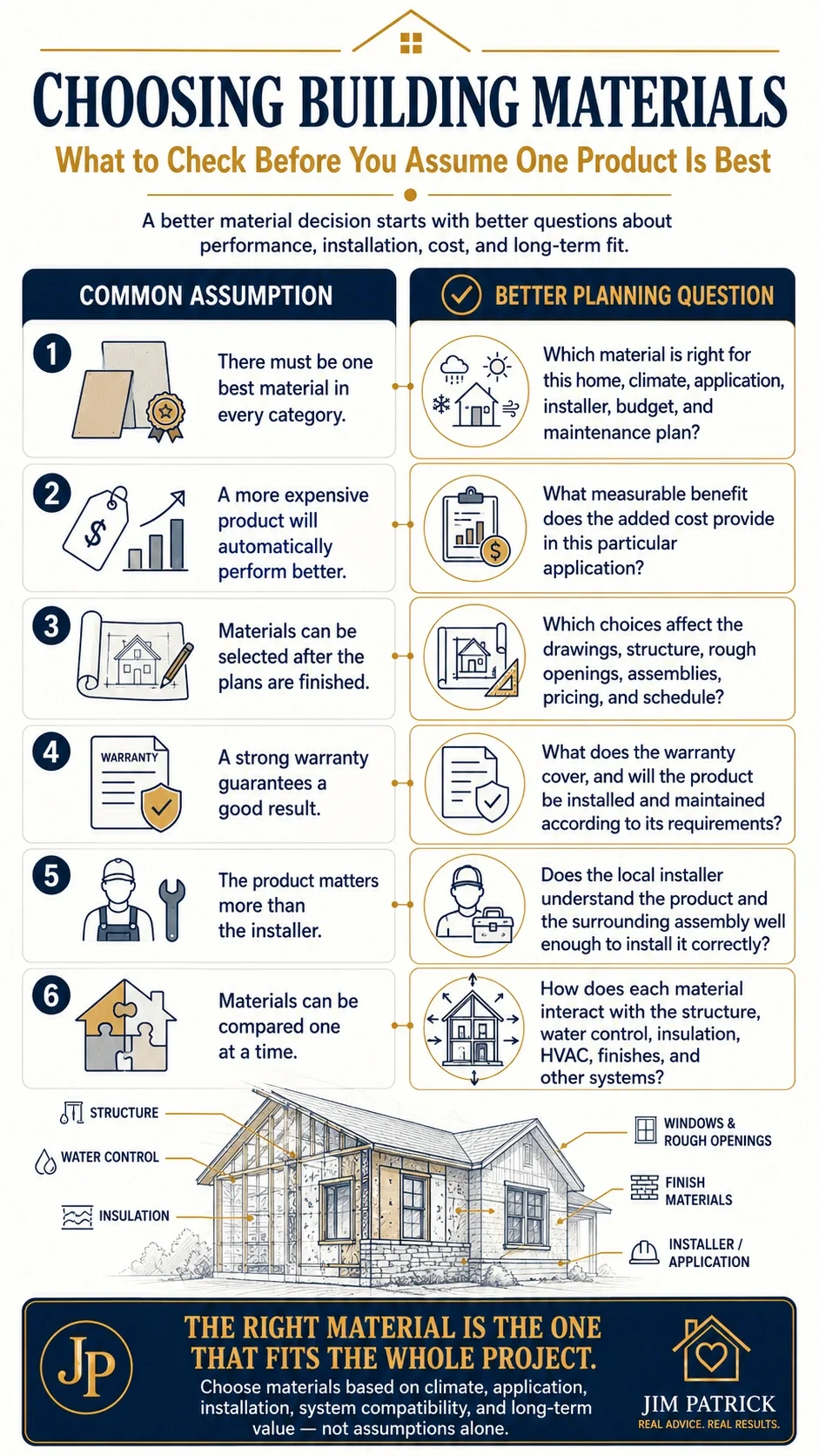
Questions I Would Ask My Clients
What job does this material need to perform?Is it appropriate for the climate and exposure?How does it affect the structure or surrounding materials?Who will install it, and have they used it successfully before?What maintenance will it require over the years?What does the warranty actually cover?Does the additional cost improve performance, comfort, durability, or only appearance?Does this decision need to be made now to protect the plans, budget, ordering schedule, or construction sequence?
Material Mistakes When Building a Home
Most material mistakes when building a home do not begin with an obviously bad product.

They begin when a material is chosen for the wrong reason.

It looked good in a photograph.

It had the lowest price.

It had the longest warranty.

Someone online said it was the best.

A salesperson described it as an upgrade.

None of those facts tells you whether the material belongs in your home.

The better question is whether it fits the structure, climate, assembly, installer, maintenance expectations, budget, and long-term plan
Mistake #1: Choosing From Appearance Alone
Samples and photographs help you judge color, texture, and style.They do not show the complete performance story.Before choosing, ask how the material handles weather, water, wear, installation, maintenance, and the conditions of your home.Mistake #2: Assuming a Premium Product Guarantees a Premium Result
The product is only one part of the outcome.Design, preparation, installation, compatibility, flashing, fastening, and maintenance all matter.Spend as much time understanding how the product will be installed as you spend selecting it.Mistake #3: Waiting Too Long to Make Major Material Decisions
Late choices may require drawing changes, structural changes, new prices, different rough openings, or schedule adjustments.Identify the systems and products that affect the plans before the project is locked in.Mistake #4: Spending Heavily on Visible Finishes While Ignoring Hidden Performance
A beautiful home still needs sound structure, water management, insulation, air sealing, flashing, ventilation, and mechanical coordination.The materials behind the walls may not receive compliments from visitors.They may have a greater effect on how the home performs for decades.Custom Home Material Selection Checklist
Use this custom home material selection checklist before the plans, structural systems, rough openings, estimates, and major product orders become difficult to change.Before choosing major building materials, review these questions:Have we identified the job each material must perform?Is the material appropriate for the local climate and exposure?Does the selection work with the structural design?Have water management, flashing, drainage, and drying been considered?Are local trades experienced with the product and installation method?Does the material work with the surrounding assemblies?Do we understand the maintenance and repair requirements?Have we read the warranty, exclusions, and installation conditions?Does the price reflect meaningful long-term value?Has the choice been made early enough to protect the plans, pricing, ordering, and schedule?
Designer’s Advice
If you were sitting across the desk from me, I would not try to tell you that one material is always best.I would ask questions.Where will it be used?What will it be exposed to?What must it support?What is behind it?What is attached to it?Who will install it?How will water be managed?What maintenance are you willing to perform?What does the added cost truly provide?Then I would ask one more question:Does this choice strengthen the whole home, or are we selecting it because it looked good on a sample board?There is nothing wrong with wanting beautiful materials.You should enjoy the way your home looks.But the materials also need to work.They need to support the structure.They need to manage water.They need to contribute to comfort.They need to fit the budget.They need to make sense for the people who will live with them.The goal is not to buy the most expensive collection of products.The goal is to create the right material system for your home.Key Takeaways
There is no single best material for every home or application.Materials should be evaluated as connected parts of the complete house.Climate, water management, installation, maintenance, and compatibility matter as much as appearance.Major structural and performance-related materials should be discussed early.The best material plan spends money where it improves performance, durability, comfort, and long-term value.
Related Checklist Section
This topic connects directly to the Exterior, Structure and Materials section of my free Dream Home Planning Checklist.That section helps you think through foundation type, rooflines, windows, exterior materials, structural expectations, maintenance, and the decisions that need to work together before the plans and prices are finalized.The checklist will not choose products for you.It will help you prepare better questions for your designer, builder, suppliers, engineers, and trades.Related Articles
What Happens Between a House Plan and a Real Construction ProjectWhy Most Stock House Plans Cost More Than ExpectedWhy Curb Appeal Starts Before You Choose a StyleThe Hidden Costs of Building a Larger HomeThe Floor Plan Walk-Through Test Every Homeowner Should Use
Ready to Start Planning?
Before you spend money on plans, permits, materials, or construction changes, make sure you are asking the right questions.Download my free Dream Home Planning Checklist and start organizing the decisions that shape your family, budget, lifestyle, building site, floor plan, materials, systems, and future.Frequently Asked Questions About Choosing Building Materials for a House
How do I choose building materials for a new home?
Begin by identifying the job each material must perform.Then evaluate the structure, climate, weather exposure, water-management system, installation requirements, local trade experience, maintenance, compatibility, warranty, availability, budget, and long-term value.Do not choose only by appearance, brand name, or price.Which building material choices should be made before construction?
Materials that affect the plans, structure, wall thickness, rough openings, pricing, or schedule should be discussed early.These may include foundation systems, floor and roof framing, windows, exterior doors, garage doors, roofing, siding, masonry, insulation strategy, large-format flooring, specialty showers, fireplaces, and major mechanical-system decisions.Colors and minor decorative finishes can usually be selected later.What are the most common material mistakes when building a home?
Common mistakes include selecting products by appearance alone, assuming a higher price guarantees better performance, overlooking installation requirements, ignoring climate and water exposure, relying too heavily on warranties, choosing incompatible materials, and postponing major selections until construction is underway.Another common mistake is spending heavily on visible finishes while overlooking the structure, flashing, drainage, insulation, and other hidden materials that affect the home for decades.Which material upgrades are worth paying for?
Material upgrades may be worth the additional cost when they improve durability, comfort, water control, maintenance, energy performance, repairability, or daily function.An upgrade that provides little practical improvement in the specific application may not be the best use of the budget.Ask what problem the upgrade solves and whether your family will continue receiving value from it years after construction is complete.Are durable building materials always more expensive?
Not necessarily.Some durable products cost more initially but reduce maintenance or replacement costs. Other proven, moderately priced materials perform very well when they are properly selected, detailed, and installed.Durability depends on more than price. Application, climate, exposure, installation, maintenance, and compatibility all matter.What should homeowners know before choosing building materials for a house?
Homeowners should understand that materials are connected parts of a complete building system. Structure, climate, water management, installation, maintenance, compatibility, performance, price, and long-term value should all be considered.The best choice is not automatically the cheapest, most expensive, newest, or most popular product. It is the material that fits the application and the complete home.When should building materials be selected?
Major structural and performance-related materials should be discussed early enough to guide the drawings, pricing, rough openings, assemblies, ordering, and construction schedule.Decorative colors and minor finishes may be chosen later, but systems such as windows, exterior doors, floor framing, roofing, siding, insulation, and masonry may affect the design much earlier.Is installation more important than the building material?
Both matter.A quality product still needs correct preparation, detailing, fastening, flashing, and installation. A less complicated product installed correctly may perform better than a premium product installed poorly or used in the wrong application.